Leshan Day Trip from Chengdu: The Giant Buddha, the Boat Question and China's Quietest Great Food City
How to do Leshan as a day trip from Chengdu: 2026 train times and prices, the boat vs stairs call, Giant Buddha crowds, and the bobo chicken food crawl.
Leshan gets filed under "the big Buddha day trip from Chengdu," and the search results reflect that: tour operators, ticket packages, and almost nothing written by anyone who cares what the town itself is like. Here is the part those listings skip. Within China, Leshan is famous twice over, once for the 71-meter Buddha carved into the river cliff, and once as one of Sichuan's great eating towns, the kind of place Chengdu residents ride 45 minutes by train to queue for duck. English coverage of the first is thin; of the second, nearly nonexistent. I have not filmed Leshan yet, but I have spent enough time in recent traveler reports and Chinese food writing to say the honest version out loud: this is a food trip with a very large Buddha attached. This guide covers both, in that spirit: the train and how to book it under the new visa-free rules, the boat-or-stairs decision answered plainly, the crowd reality at the top, and the crawl through bobo chicken, qiaojiao beef and sweet-skin duck that should shape your afternoon.
One ticket, two different day trips
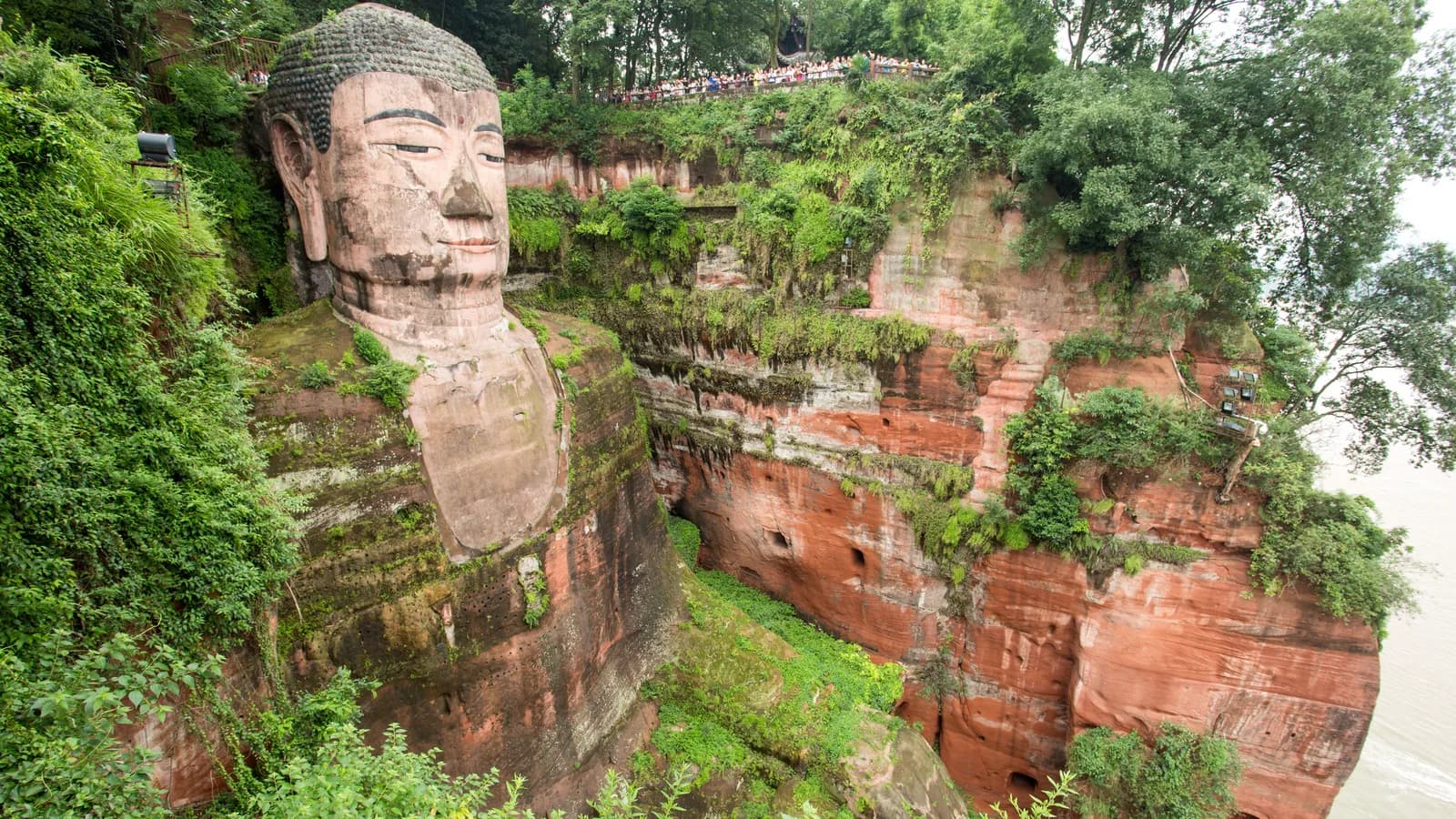
The Buddha needs little introduction: the largest stone Buddha in the world, begun in 713 by a monk who believed a guardian figure would calm the shipping-killing currents where three rivers collide, finished 90 years later, toes long enough to seat a picnic. It anchors Chengdu's day-trip menu alongside the pandas and Sanxingdui, and on that menu it is the single biggest sight in Sichuan.
But watch what domestic travelers actually do with Leshan and a second itinerary appears. Chinese social feeds treat the town as a food pilgrimage first, with whole trip reports that never mention the Buddha at all. The town's own tourism office publishes food-street maps with more enthusiasm than it publishes Buddha guides. That double identity is the practical insight for planning: the Buddha takes a morning, the food takes an afternoon and evening, and the day trip only disappoints people who budget the whole day for the statue and then stand in its queue. Do the Buddha early, eat from 1pm onward, catch an evening train back.
The train, and why it sells out now
The logistics are the easy part, on paper. The intercity high-speed line runs from Chengdu East and Chengdu South to Leshan station in 45 minutes to just over an hour, around ¥54 in second class, with roughly 70 departures a day continuing on to Emeishan. From Leshan station, bus K1 rolls to the Giant Buddha scenic area in about 30 minutes for ¥2, and a taxi or Didi does the same run in about 20 minutes for ¥25–30.
The catch is demand. China's 240-hour visa-free transit policy now covers citizens of 55 countries, Chengdu's airports are eligible entry ports, and Sichuan is a permitted stay area, which means the Chengdu gateway is carrying far more foreign traffic than its infrastructure of English-language advice assumes. Recent reports describe weekend and holiday trains to Leshan selling out days ahead, and since 2023 there are effectively no walk-up paper tickets: everything is sold real-name through 12306, its WeChat mini-programs, or international front-ends like Trip.com. The system is paperless, and your passport is the ticket; you scan it at the gates at both ends.
So the booking rhythm looks like this. Trains open for sale about two weeks out. Book your outbound the moment your dates are fixed, book a return for a specific evening train rather than gambling on availability, and put your passport number in exactly as printed. Buddha entry works the same way: the scenic area sells real-name tickets up to 30 days ahead through its official channels, and pre-booking through an international platform saves you negotiating a Chinese-language ticket machine at the gate. It is the same lesson the Huangguoshu day trip teaches at the other end of China's high-speed network: the train is the cheap, fast, obvious answer, and the only way to lose is to leave the booking late.
If you would rather compress all of that into one purchase, the packaged options are legitimate here too.
Three things worth booking
 DIY essential
Giant Buddha entry and river cruise tickets
Pre-booked entry sidesteps the Chinese-language ticket queue, and slots genuinely sell out on holidays. Book the cruise separately if you want the full-height river view.
Book this Easiest logistics
Leshan day tour from Chengdu
One booking covers pickup, transport, and entry. The trade is the tour clock: most groups hit the staircase at peak queue hours and skip the food streets entirely.
Book this The double-header
Leshan + Mount Emei combo day
Buddha in the morning, Emei's temples in the afternoon, back late. Doable, but it trades the Golden Summit and the food crawl for the checklist. Read the Emeishan section before booking.
Book thisBoat or stairs: the honest answer
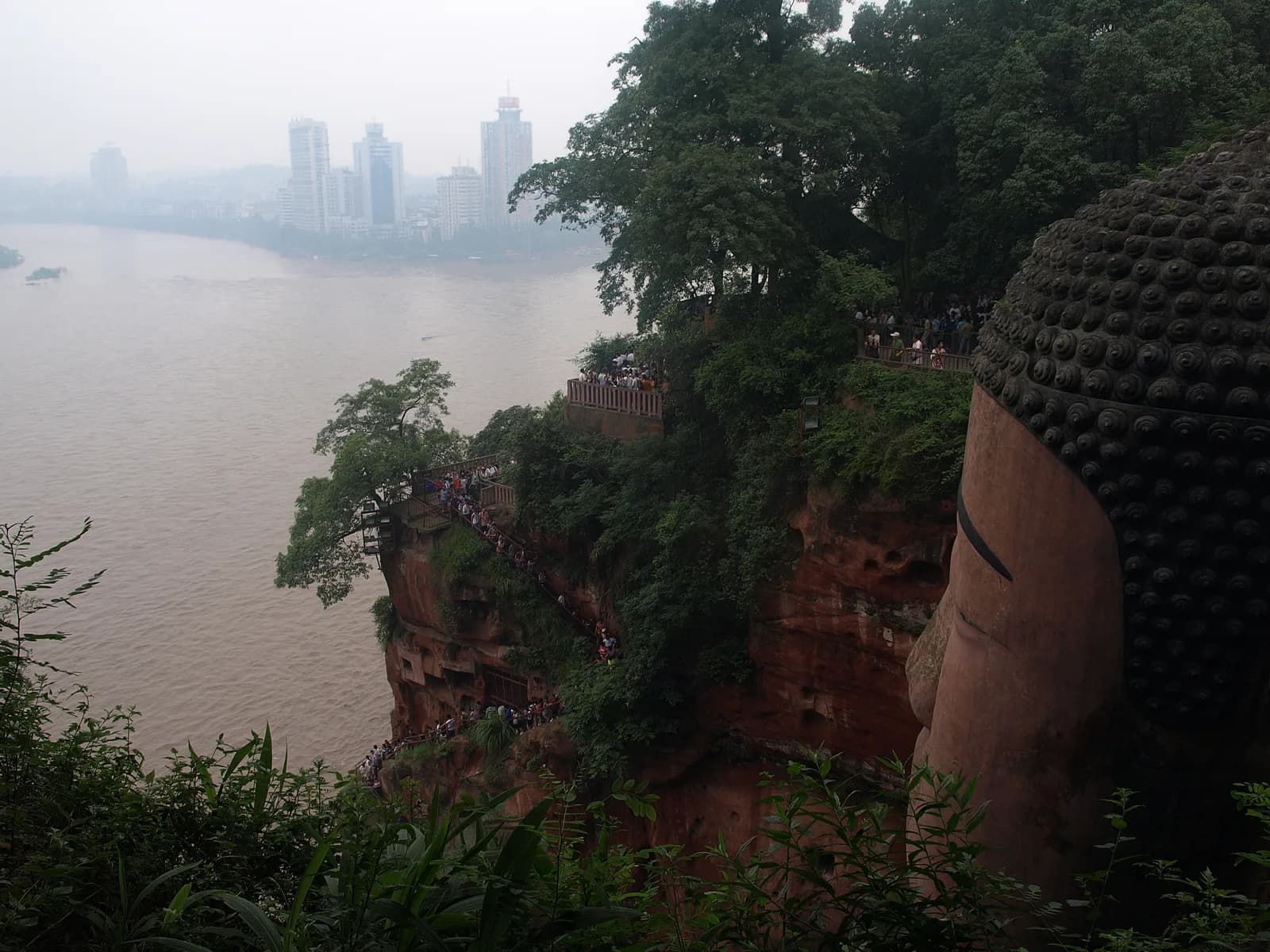
Every Leshan post eventually faces the same fork, so here it is without suspense: take the boat first, and climb only if the queue at the staircase entrance looks short. That is the consistent verdict across recent traveler accounts, and the reasoning is simple geometry. The Buddha is 71 meters tall and carved into a concave cliff face. From the platforms inside the park you see it in pieces, head level here, feet level there. From the river you see the whole figure at once, flanked by the two carved guardian warriors that platform visitors never notice, with the outline of the "sleeping Buddha" hills behind it.
The cruise leaves from the wharves on the Min River north of the site, costs ¥70, does not require the ¥80 park ticket, and takes about 30 minutes, of which 10 to 15 are spent holding position in front of the statue while everyone crowds the photo-side rail. Boats fill and go, so the wait is usually the length of the loading queue. A night-cruise version runs about ¥120 in summer.
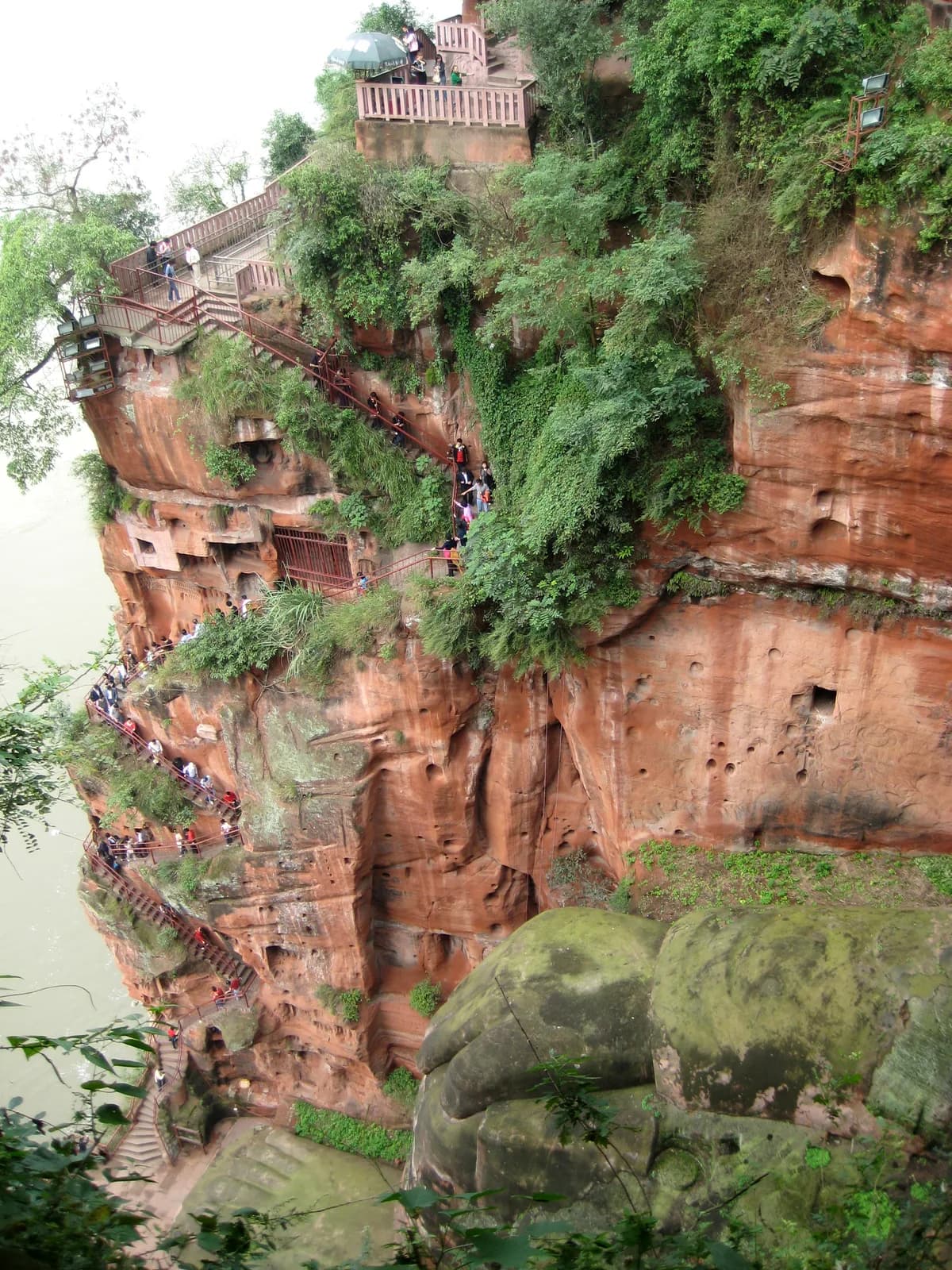
The staircase is the opposite experience: a 90-minute to three-hour circuit through Lingyun Temple to the platform beside the Buddha's ear, then down a narrow Tang-era stairway cut into the cliff, single-file, to the feet. At the bottom the scale finally lands, toes taller than the people photographing them. The cost is the queue, covered honestly in the next section.
| River cruise | Cliff staircase | |
|---|---|---|
| Price | ¥70, park ticket not needed | Included in ¥80 entry |
| Time | ~30 min + boarding queue | 1.5–3 hrs, plus the queue itself |
| The view | Full figure in one frame, guardians, sleeping-Buddha hills | Details: the ear, the drainage system, the feet |
| Crowds | Rail-space jostling for 15 minutes | 1–2 hr single-file waits midday, worse on holidays |
| Skip it if | You want to touch the stone | You arrive after 10am on a weekend |
The genuinely good pattern for a full morning: cruise first for the postcard, then enter the park and decide about the staircase with your own eyes. If the switchbacks above the stairway are already packed, the platform beside the head plus Wuyou Temple across the footbridge make a queue-free park visit that recent visitors rate highly on its own.
The crowd reality, and how to time around it
The uncomfortable truth about one of China's most famous sights is that its bottleneck is a stairway wide enough for one person. Between 10am and 2pm on any busy day the queue backs up the cliff, and recent accounts describe an hour or more of standing in direct sun before the descent even begins; on national holidays the waits stretch to several hours, which is why every China travel forum repeats the same advice: never do Leshan during Golden Week.
The fix is timing, and it is very learnable. Gates open at 7:30am in peak season (April 1 to October 7, closing 6:30pm) and 8am in winter. Independent travelers who catch a train out of Chengdu East around 7am are inside the park before 9, down the staircase before the tour coaches from Chengdu arrive, and free by lunchtime, which is exactly when this itinerary wants you free. Weekday mornings are consistently described as calm, even pleasant; the same stairway on a Saturday afternoon is the worst queue in Sichuan. If you cannot make an early train, flip the day: eat first, then walk into the park after 3pm as the coaches pull out, the same late-afternoon trick that works at every headline sight in China.
The food crawl: what Leshan is actually famous for at home
Here is where the English internet goes quiet and the Chinese internet gets loud. Leshan's food reputation inside Sichuan is enormous, and the crawl below is built from what domestic eaters and the handful of English-language food writers who cover the town keep converging on.
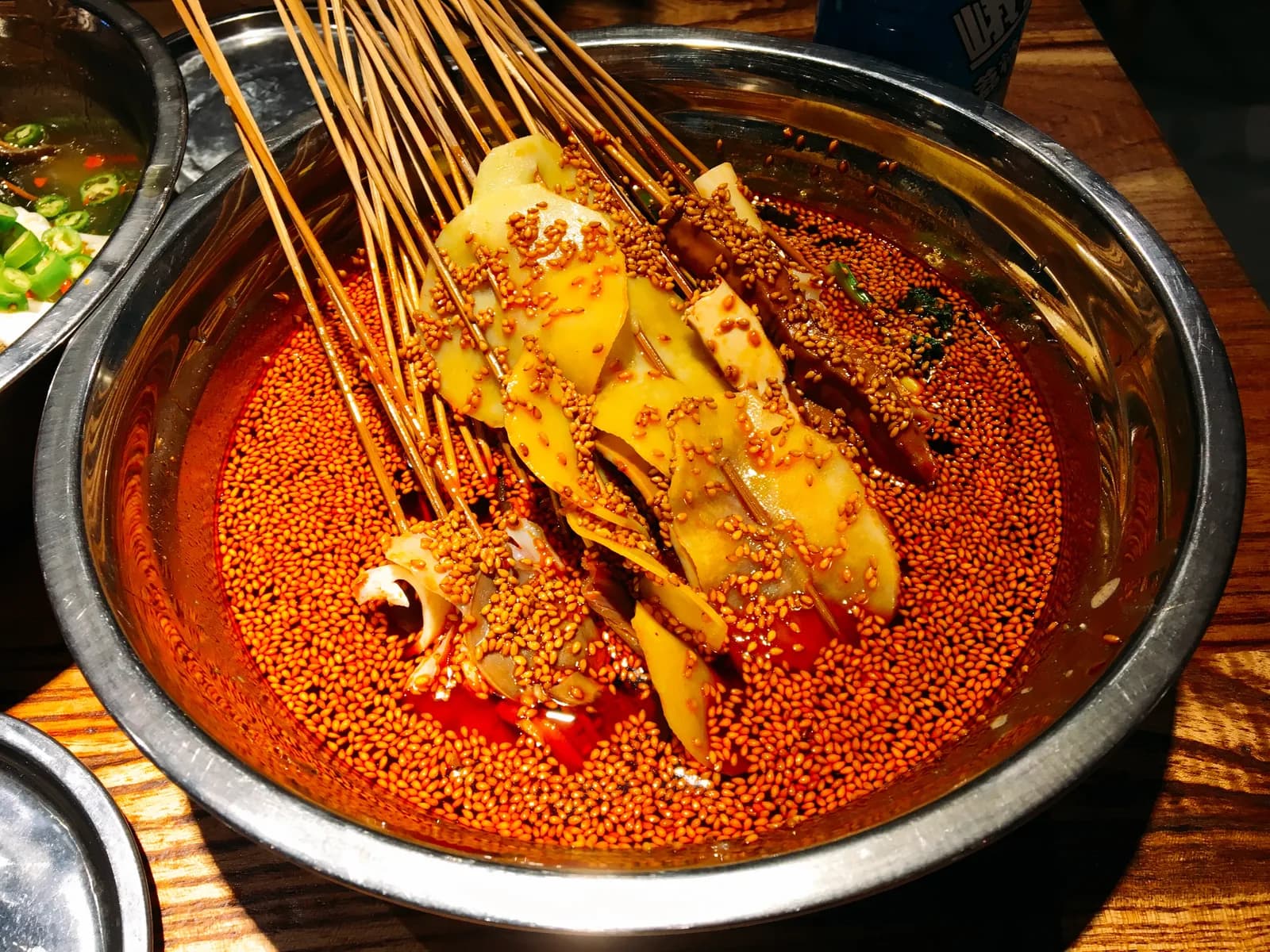
Bobo chicken (bo bo ji). The town's signature, named for the clay pot it arrives in: skewers of poached chicken, lotus root, wood-ear mushroom, kelp and quail eggs steeping cold in a spiced red chili oil or a green rattan-pepper version that numbs more than it burns. You pull skewers from the communal pot and settle up by the empty sticks at the end. The format made me sit up when I first read about it, because it is structurally oden, the convenience-store skewer pot I grew up fishing dinner out of in Japan, except run cold and dressed in chili oil, comfort food passed through a completely different climate logic. The name that dominates recent reports is Ye Popo, the decades-old shop whose broth is simmered with a reported twenty-plus spices, but bobo chicken is everywhere in Leshan and the pot on the counter tells you how seriously a shop takes it.
Qiaojiao beef. "Tilted-foot beef," after the rail under the old market tables where diners once propped their feet. Beef and beef offal poached in a clear, herbal bone broth, served with a dry chili dip, and far gentler than its offal billing suggests; the broth is the point. The dish was born in Suji Ancient Town, a short taxi ride from central Leshan, where old-school specialists like Fangfang and Yi Laoba run copper cauldrons that have not cooled in years, at around ¥35 a head. If the Suji detour does not fit the day, qiaojiao houses in town serve the same bowl closer to the Buddha.
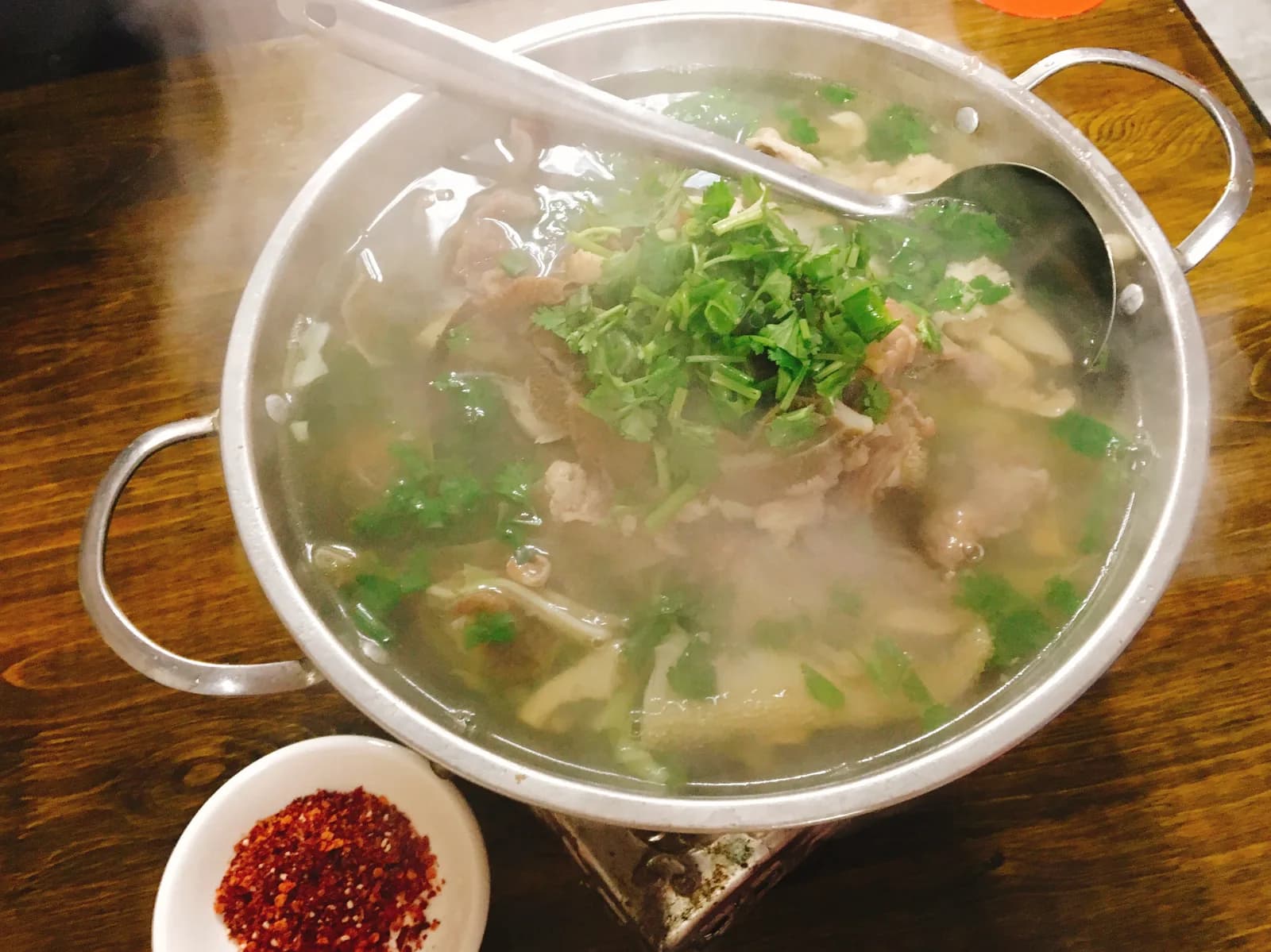
Sweet-skin duck. The queue-generator. A whole duck brined, fried, then painted with molten maltose so the skin sets into a thin caramel shell over the meat, sold by the half from counters that glaze in real time. The maltose trick reads instantly to anyone raised around Japanese sweets; it is the same sugar that gives mizuame candy its glassy coat, here doing savory work. The two names recent reports repeat are Zhao Yazi, the drier, crisper style, and Ji Liuniang, the sweeter glaze, old neighbors with loyalists on both sides. Buy a half duck, eat it standing there, and you will understand why Chengdu residents carry boxes of this stuff home on the train.
Thread it together at Zhanggongqiao food street, the canal-side stretch that turns into the town's open-air dinner table after dark: bobo chicken pots, duck counters, grilled skewers, and the ice-jelly desserts that put the fires out. If you want the eating narrated and translated, a small-group Leshan boat-and-food half-day trip pairs the river cruise with the crawl. Either way, the food is the argument for the later train home, and it is a stronger argument than a second hour with the Buddha. The chili here plays a different game from Chengdu's, colder, oilier, more patient, and tasting the two cities against each other 45 minutes apart is the best food comparison in the province.
Should you tack on Emeishan?
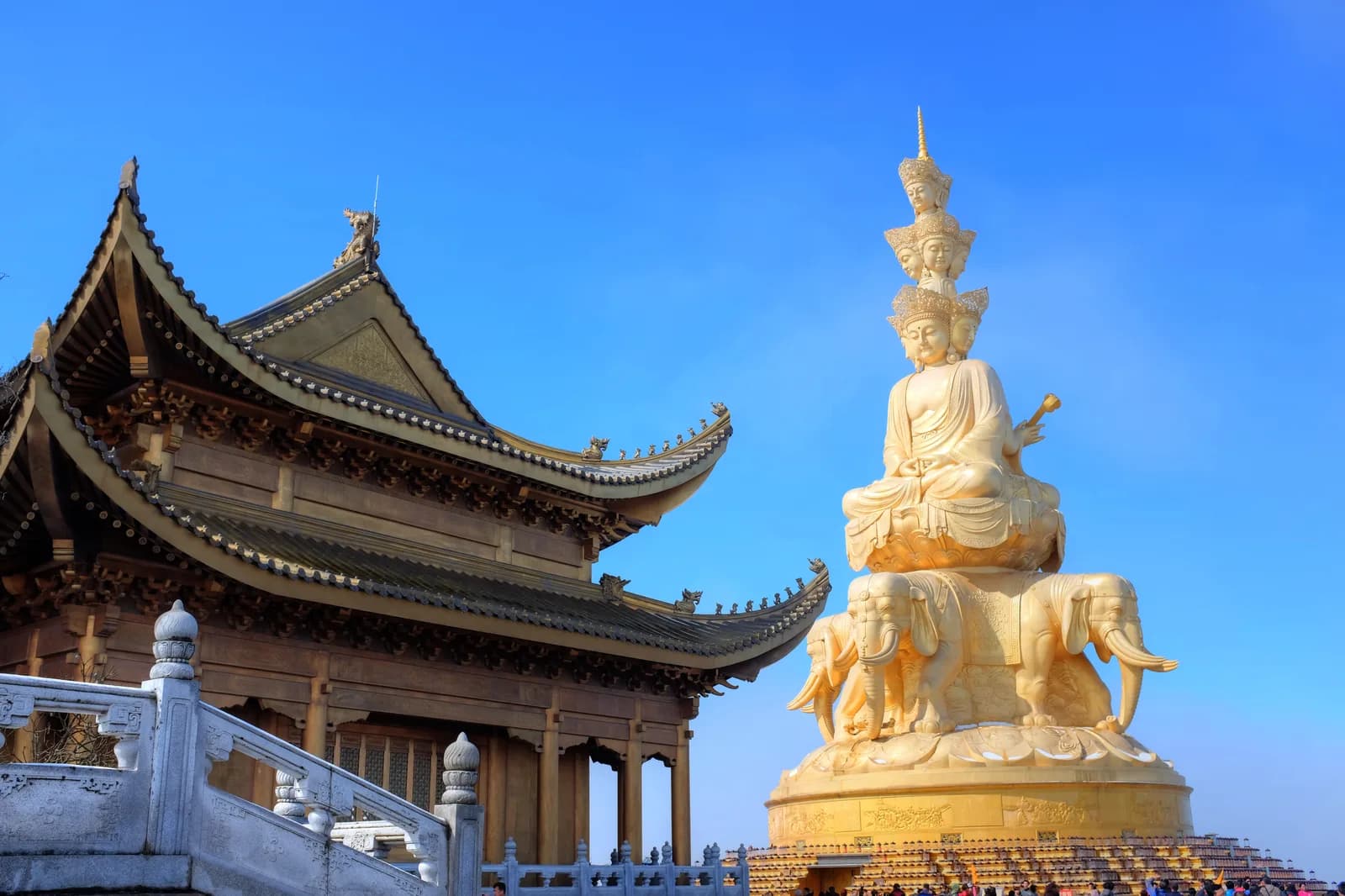
The map makes it tempting: Emeishan station is 11 to 23 minutes past Leshan on the same line, ¥11–32, with about 30 trains a day. The mountain is the real thing, one of Chinese Buddhism's four sacred peaks, with the 48-meter golden Puxian statue on its 3,079-meter summit and monkeys running protection rackets on the trails.
But stacking it onto a Leshan day is where good trips go to die. Reaching the Golden Summit means a scenic-area bus to Leidongping, a cable car, and a final walk, roughly two hours each way from the mountain gate before you have looked at anything, and the summit's famous moments, the sunrise and the sea of clouds, belong to people who slept at Leidongping or beside the summit itself. Recent visitors who day-tripped it describe arriving in midday fog alongside every tour coach in Sichuan and wondering what the photographs were taken of. The consistent verdict: Leshan is a day trip, Emeishan is an overnight, and the combo tours that promise both in one day deliver the temples at the foot of the mountain, not the summit.
So the honest decision tree is short. One spare day from Chengdu: Leshan, this itinerary. Two spare days: Leshan on day one, sleep at Emeishan, summit at dawn on day two, train straight back to Chengdu. Half a spare day and a checklist: the combo tour exists, and at least now you know what it trades away.
Where to sleep it from
For most travelers this is settled before it starts: base in Chengdu and treat Leshan as the 45-minute excursion it is. The city has the hotel stock, the metro, the evening hotpot and the airport connections, and staying near Chunxi Road puts you 20 minutes from Chengdu East station; my Chengdu neighborhood guide argues the zone-by-zone case, and the things-to-do guide slots Leshan into the wider week.
Sleep in Leshan itself if the food is your headline act. An overnight buys you Zhanggongqiao at full evening tilt without a train to catch, the night cruise past the floodlit cliff, and a 7:30am walk into the park before the first coach from Chengdu clears the tollgate. Hotel stock skews local mid-range, clustered near the scenic area and the old town, at prices that make Chengdu look expensive. And sleep at Emeishan, either at the mountain-foot hot-spring hotels or up at Leidongping, only if you are committing to the summit sunrise; that overnight is about the mountain, not the town.
Recommendations
- Book the train the day sales open, about two weeks out, and lock a specific evening return; weekend trains genuinely sell out under the visa-free surge.
- Carry the passport you booked with; it is your train ticket and your park ticket, and nothing at Leshan runs without it.
- Be on a train from Chengdu East around 7am, or flip the day and enter the park after 3pm; the 10am-to-2pm window belongs to the coaches.
- Take the ¥70 boat before deciding on the staircase, and let the size of the queue make the second call for you.
- Pre-book park entry online in summer and on any holiday; same-day slots are not a given anymore.
- Give the food half the day: bobo chicken and sweet-skin duck in town, qiaojiao beef in Suji if you can stretch the taxi ride.
- Buy sweet-skin duck by the half from whichever counter is glazing in real time, and eat it before it travels.
- Skip the Leshan-plus-Emei combo unless a checklist matters more than the Golden Summit; the mountain deserves its own night.
- Bring sun cover and water for the staircase queue; recent reports mention the exposed wait more often than the stairs themselves.
Leshan rewards the traveler who inverts the itinerary everyone else runs: Buddha at 8am when the stairway is quiet, boat before lunch, and the whole long afternoon surrendered to clay pots of chili oil and caramel-skinned duck. That is the version I would book next week, and it is the version almost no English guide describes. If you have eaten your way through Zhanggongqiao recently, or the prices and timetables here have moved, tell me and I will update this. And if this is your first China leg under the 240-hour rules, the Chengdu base guide is the place to start; the train does the rest.
Frequently asked
How do you get from Chengdu to Leshan by high-speed train?
Take the intercity high-speed line from Chengdu East or Chengdu South to Leshan station, 45 minutes to just over an hour for around 54 yuan in second class, with roughly 70 departures a day. From Leshan station, bus K1 covers the last stretch to the Giant Buddha in about 30 minutes for 2 yuan, or a taxi or Didi does it in 20 minutes for about 25 to 30 yuan. Book the train on 12306 or Trip.com with your passport; the passport itself is your boarding document.
Should you take the boat or climb the stairs at Leshan Giant Buddha?
Boat first, stairs only if the queue looks sane. The 70-yuan river cruise takes about 30 minutes and holds position in front of the Buddha for 10 to 15 minutes, the only way to see all 71 meters in one frame. The cliff staircase puts you at the Buddha's feet but is a narrow one-way path that jams badly between 10am and 2pm, with waits of one to two hours on busy days and worse on holidays.
How much does the Leshan Giant Buddha cost to visit?
The scenic-area entry ticket is 80 yuan at full price, covering the Buddha staircase, Lingyun Temple, the Mahao Cliff Tombs and Wuyou Temple. The river cruise is a separate 70 yuan and does not require the entry ticket, and a night cruise runs about 120 yuan. Add roughly 110 yuan for round-trip second-class trains from Chengdu and a few yuan for local buses.
Can you visit Leshan under China's 240-hour visa-free transit policy?
Yes. Citizens of 55 countries, including the UK, US, Australia and New Zealand, can enter China visa-free for up to 240 hours when transiting to a third country, and Chengdu's airports are eligible entry ports with Sichuan among the permitted stay areas. Leshan sits inside Sichuan, so the day trip is fully within the rules. You still need your passport for train tickets and the scenic-area gates, since everything is real-name.
What food is Leshan famous for?
Within China, Leshan is treated as one of Sichuan's great eating towns. The big three are bobo chicken, cold skewers pulled from clay pots of chili or green-peppercorn oil; qiaojiao beef, beef and offal simmered in a clear bone broth that originated in nearby Suji Ancient Town; and sweet-skin duck, brined, fried and glazed with molten maltose. Zhanggongqiao food street is the evening hub for all of it.
Should you do Leshan or Emeishan as a day trip from Chengdu?
Leshan is the better single day: compact logistics, a guaranteed headline sight, and the food city around it. Emeishan done as a day trip means buses, cable cars and a summit you reach at the same hour as every tour coach, and recent visitors consistently say the mountain only makes sense with an overnight for the sunrise. If you want both, either book a long combo-tour day or give Emeishan its own night.
How crowded does the Leshan Giant Buddha get?
Genuinely crowded in the middle of the day. The staircase is single-file, so between 10am and 2pm the queue can hold you for an hour or more in direct sun, and holiday waits stretch to several hours. Weekday mornings are consistently reported as calm; arrive when gates open at 7:30am in peak season, or take the boat and skip the queue entirely.
More from the journal
Qianling Park, Guiyang: The Macaques, Hongfu Temple and How to Visit Without Losing Your Snacks
Emeishan Day Trip from Chengdu: What One Day on Mount Emei Really Buys You (and When to Stay the Night)
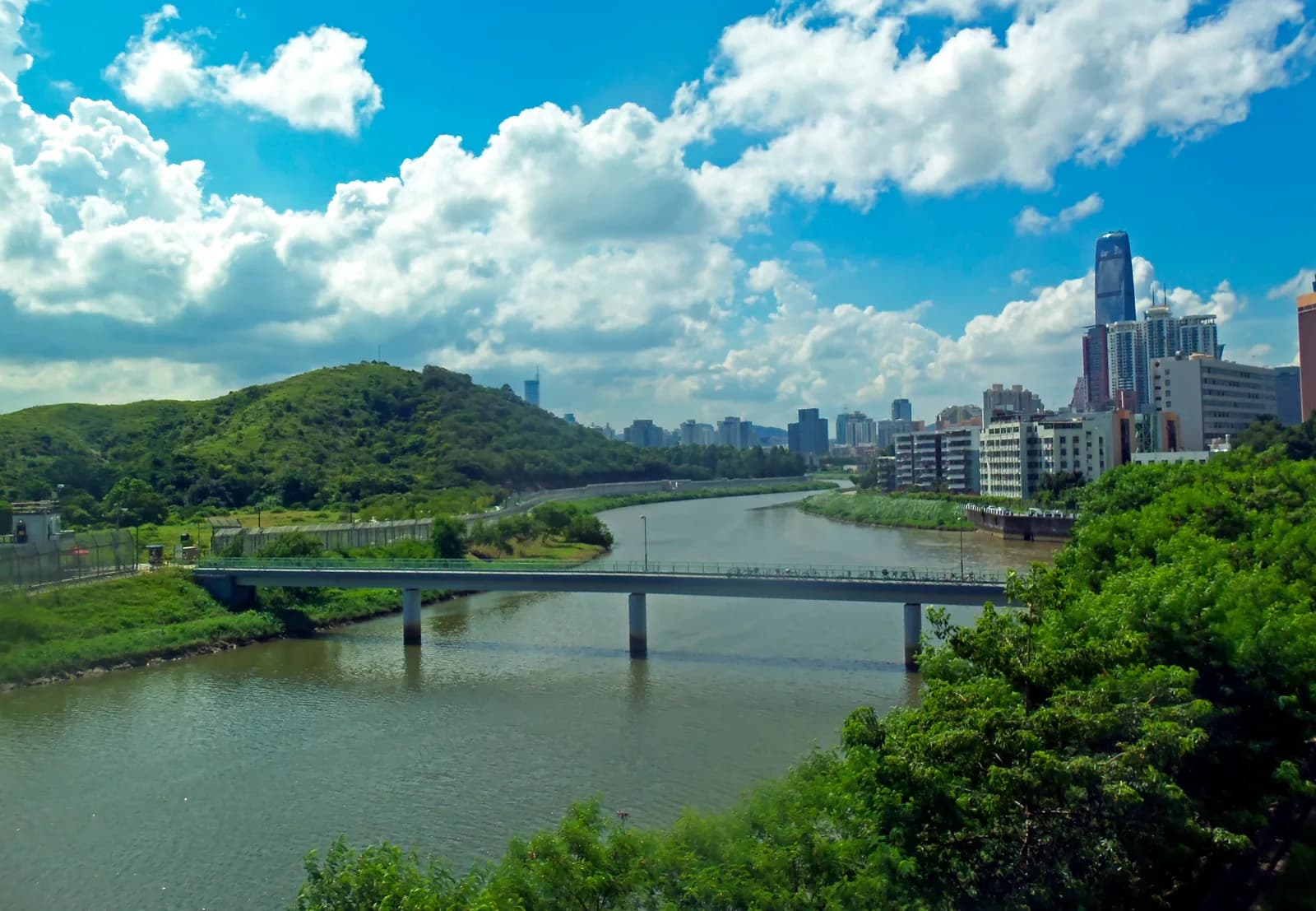
Hong Kong to Shenzhen Border Crossings: All Seven Doors Compared, and Which One Your Day Actually Needs