Huanggang Port Guide: Shenzhen's 24-Hour Border Crossing, the New Terminal, and How to Reach It from Hong Kong
Huanggang Port in 2026: the new one-stop terminal opened 12 October, coach pickups and HK$ fares from Hong Kong, the overnight crossing, Line 7 and Futian hotels.
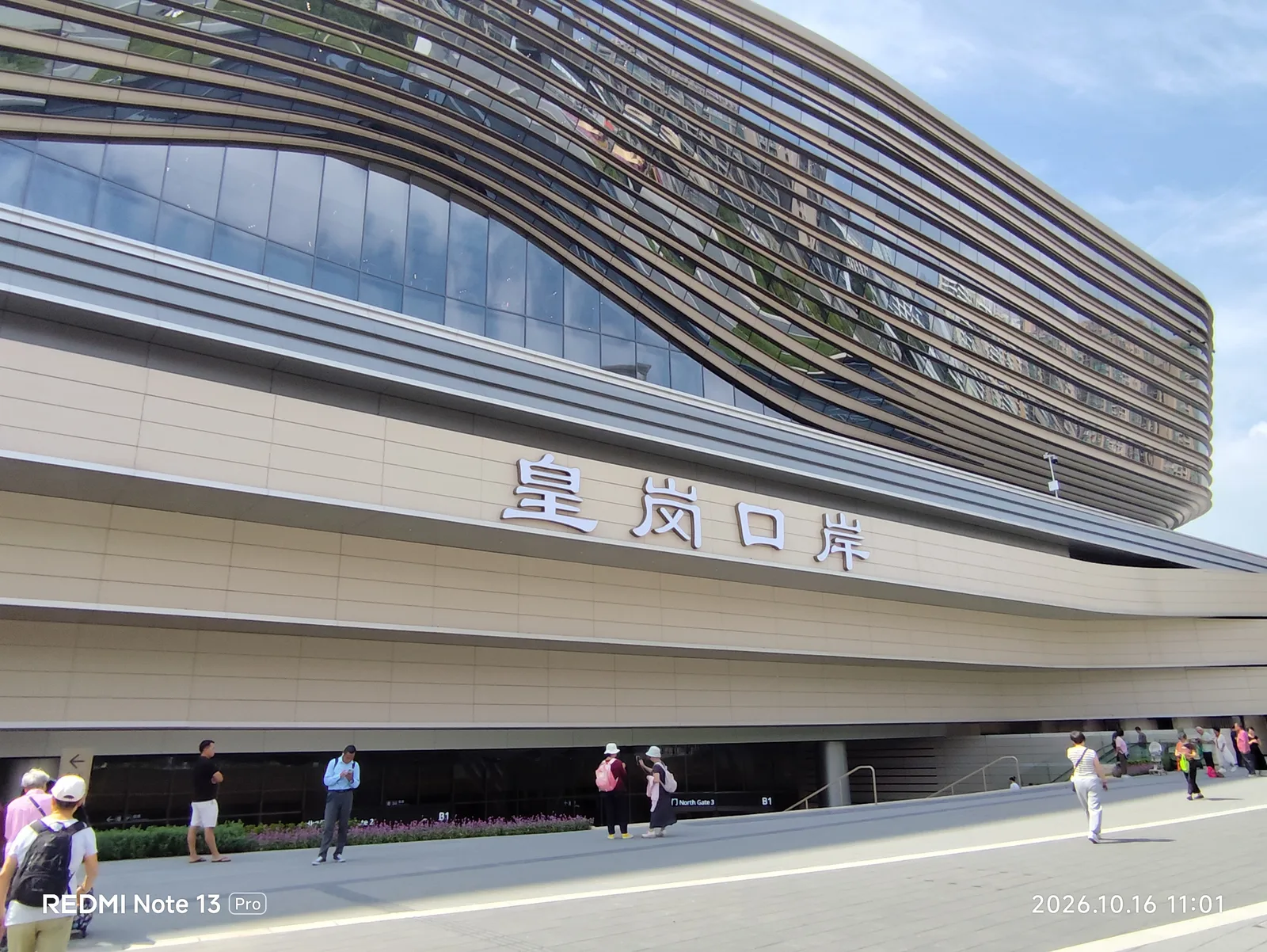
In the full crossings comparison I wrote in August, Huanggang got one section and a promise: the rebuilt port was mid-commissioning, had just passed a 10,000-person stress test, and I said I would write it up properly once it opened. It opened. At 6:30am on 12 October 2026 the new terminal took its first passengers, the 37-year-old Lok Ma Chau Control Point across the river stopped processing people the same minute, and the yellow shuttle bus that linked the two sides since 1997 made its last run. I have not crossed at the new building yet, so this is built from the government notices, three weeks of Hong Kong and Shenzhen press coverage, the Transport Department's route tables and the traveler accounts those stories quote. Where they disagree, I say so.
One sentence on paperwork, because it decides whether any of this applies to you: the visa guide covers who enters visa-free and who needs the 5-day Shenzhen port visa, and Huanggang remains one of the ports with a visa desk, though I would confirm its exact location in the new building before relying on it. From here on, logistics only.
What opened on 12 October, and what changed
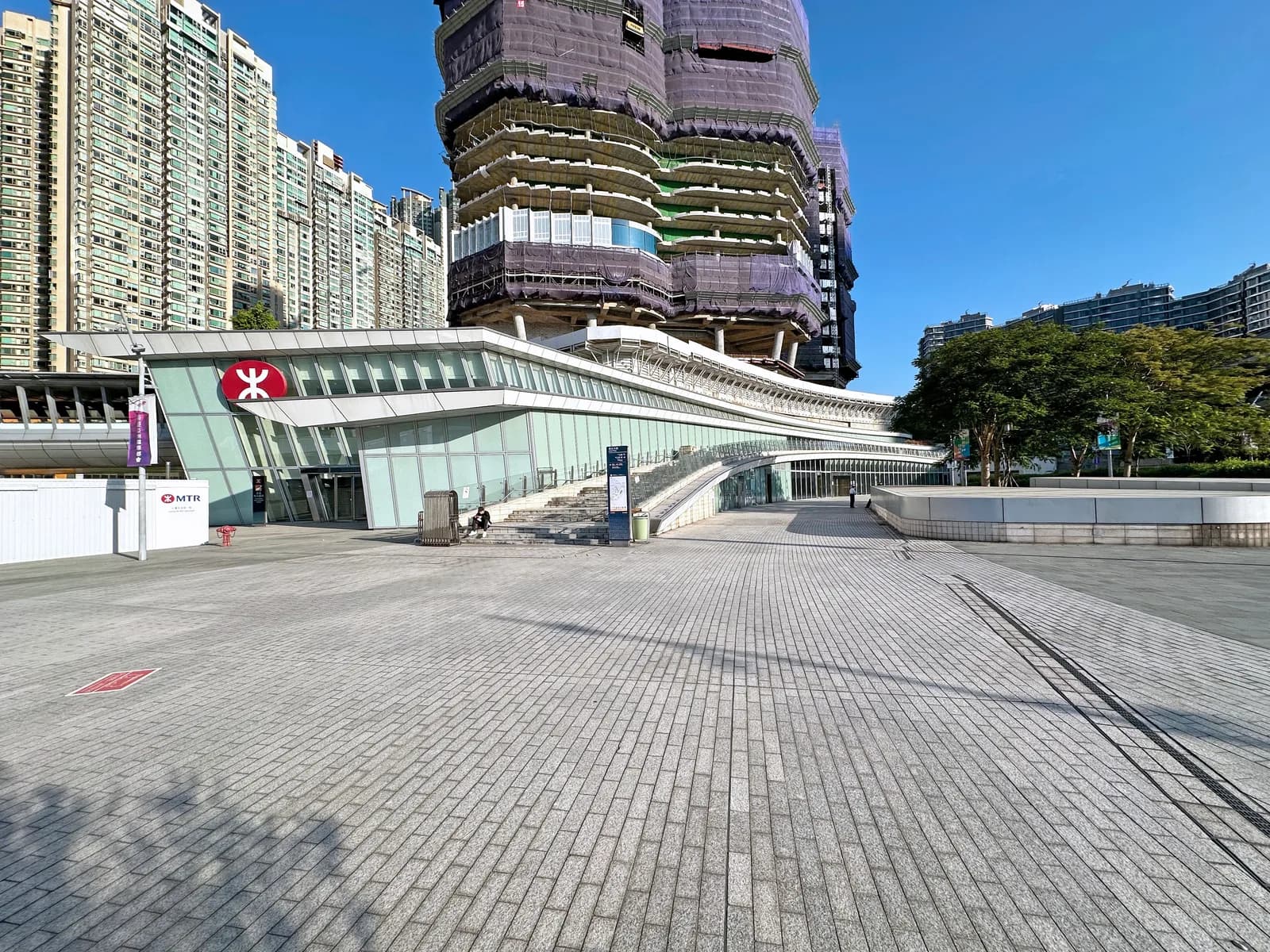
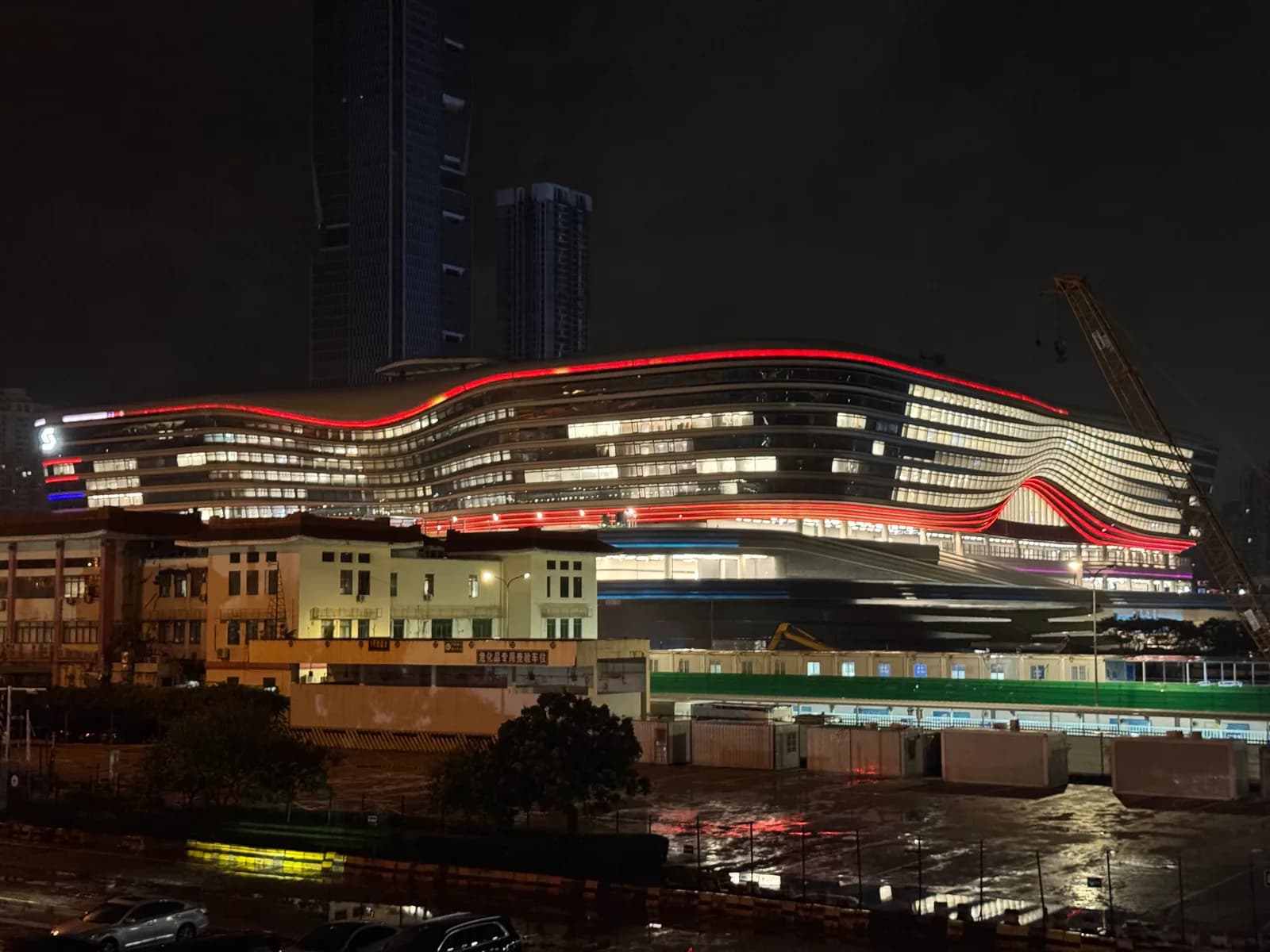
The headline change is co-location. The old Huanggang was a two-building crossing: Hong Kong exit control at Lok Ma Chau, a HK$10 yellow bus across the Shenzhen River, then mainland entry at Huanggang, roughly half an hour on a good day and far longer when the bus queue backed up. The new port puts both sides' officers in one Shenzhen building, with a legally defined Hong Kong Port Area that came under Hong Kong jurisdiction at midnight on 31 July 2026. You queue once, present your document once, and leave the building in the other country.
The numbers behind it, from the Security Bureau's own description: 134 automated "collaborative inspection" channels against 39 traditional e-channels at old Lok Ma Chau, 68 manual counters against 45, 26 vehicle clearance kiosks against 20, and a design flow of 200,000 passenger trips a day. The old port averaged around 40,000. On opening day it handled 79,500 passenger trips and about 8,000 vehicle movements; the first Chung Yeung long weekend pushed a record 152,000 through in a single Sunday, far less smoothly.
The automated joint channels are enrolled for Hong Kong permanent ID holders carrying a mainland travel permit and for mainland residents with the right endorsement; ordinary foreign passports are not on that list. You use the manual counters, where the reporting describes Shenzhen and Hong Kong officers working side by side at the same workstation, each completing their own check while you stand in one place. An American passport holder quoted on opening day said the whole thing took under a minute. My sources conflict on private cars: a widely shared Trip.com guide says they cannot use the co-location arrangement, while the official notice covers "passengers and passenger vehicles" and opening-week reporting shows drivers clearing, slowly, at the 26 vehicle kiosks. I trust the official line: cars cross here.
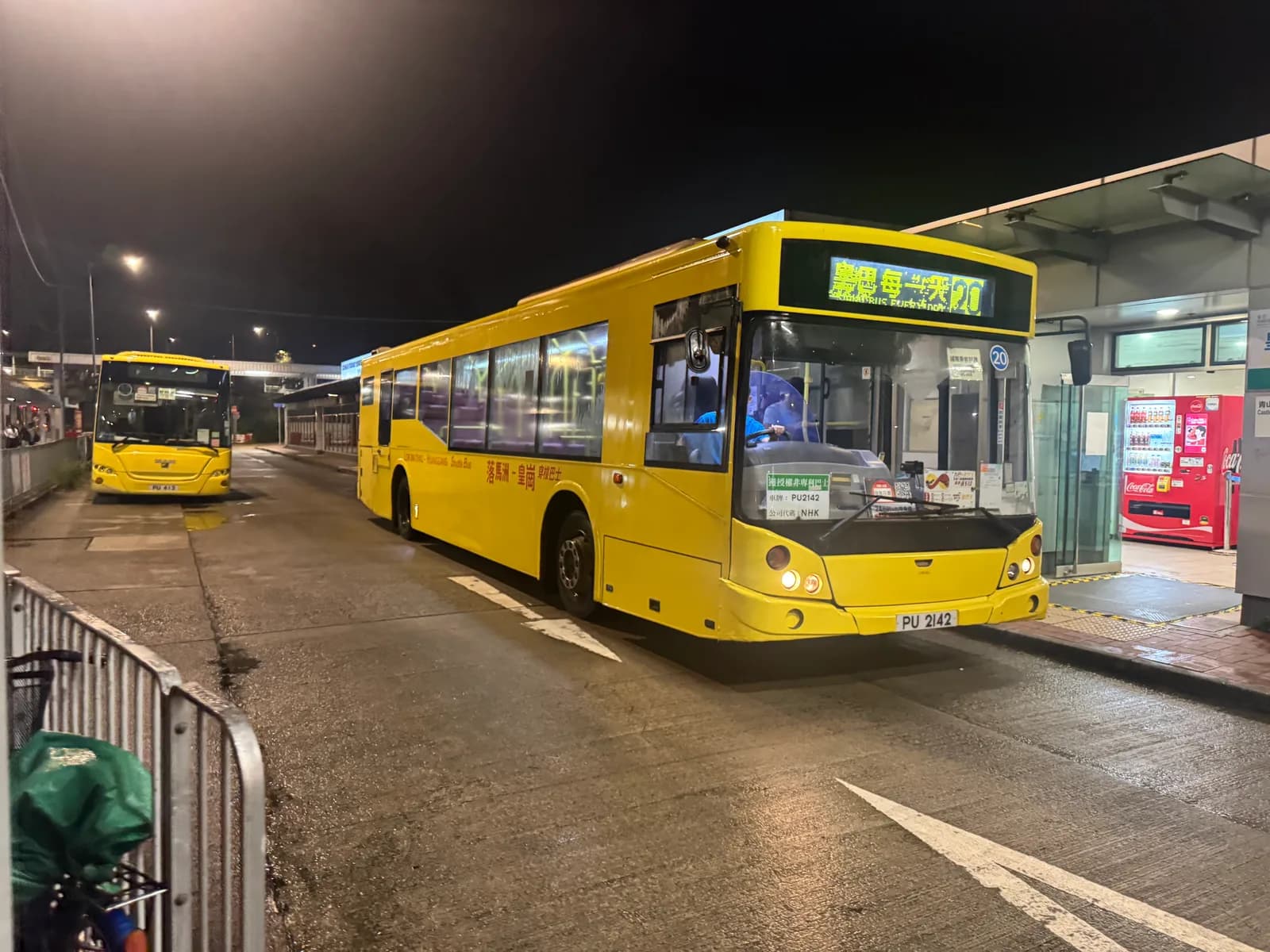
Two things vanished with the opening and still appear in older guides. The Lok Ma Chau to Huanggang shuttle, the "Huang Bus" that cost HK$10 and ran every fifteen minutes around the clock, finished its final northbound trip at 6:15am on 12 October. And the Lok Ma Chau Control Point itself has ceased passenger inspection. It is not the same place as Lok Ma Chau station on the MTR's East Rail Line, which still runs and still feeds the Futian Checkpoint crossing next door.
Getting to Huanggang from Hong Kong
There is still no rail to the Hong Kong side, and there will not be until the MTR's Northern Link reaches the port, currently pencilled in for 2034. Everything is road, which is exactly why Huanggang suits the late flight and the heavy suitcase: you board in the city and step off inside the terminal's L2 coach bays.
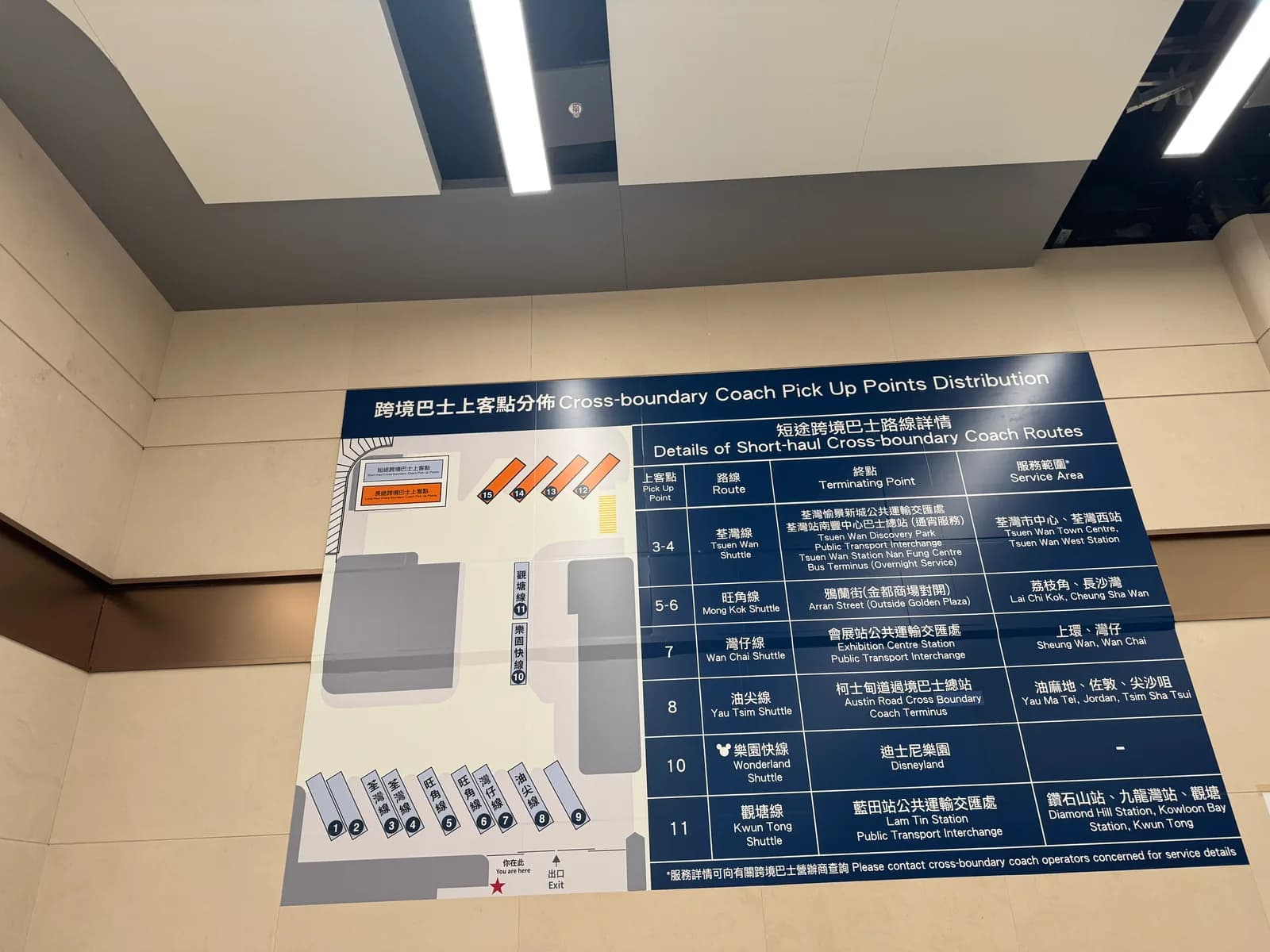
Short-haul cross-boundary coaches are the backbone, and the Transport Department lists five routes, all operating 24 hours with the fare rising a few dollars overnight. Mong Kok departs from Arran Street outside Golden Plaza, HK$45 by day and HK$50 between 11:31pm and 6am, with stops in Prince Edward, Cheung Sha Wan and Lai Chi Kok. Wan Chai runs from the Exhibition Centre Station public transport interchange, HK$57–63, picking up through Sheung Wan and Admiralty. Yau Tsim leaves the Austin Road Cross Boundary Coach Terminus in Tsim Sha Tsui, HK$50–55, with Jordan and Yau Ma Tei stops. Kwun Tong starts at Lam Tin Station, HK$55–60, via Kwun Tong, Kowloon Bay and Diamond Hill. Tsuen Wan uses Discovery Park by day and Tsuen Wan Station overnight, HK$45–48. A sixth, the Wonderland shuttle from Disneyland, is daytime only at HK$80–100. Same operators as old Lok Ma Chau; they now set you down upstairs from immigration. Octopus works at most stands, though overnight coaches have historically preferred cash.
Franchised buses are new with the port and much cheaper. KMB's B11 from Tin Shui Wai and Yuen Long is HK$10.5; the B10 from Kwai Chung via Tsing Yi is HK$12.1; New Lantao's B12 from Wu Kai Sha via Science Park is HK$21; Citybus B13 is the Hong Kong Island route, HK$27.6 from Siu Sai Wan via North Point, Central and the Western Harbour Crossing, running 6am to 12:30am. The B14 serves Kai Tak Sports Park only at peak hours and the B15 from Tuen Mun only on weekends. Overnight, KMB's NB73 links the port with Sha Tin and Sheung Shui between roughly midnight and 5:30am for HK$22.6, and three night minibuses cover Tin Shui Wai (79S), Tuen Mun (N44B) and Mong Kok via Kowloon Tong (616S, HK$28.5).
Taxis and transfers complete the picture. Red urban taxis and green New Territories taxis can both enter the port's public transport interchange, and a ticketed queuing system was introduced for taxis at the buffer zone after the first weekend. There is no public car park, so driving yourself in and parking is not an option. For the airport-to-Shenzhen case, the cross-boundary MPV and coach operators that run from HKG via Shenzhen Bay also serve Huanggang.
Worth booking before you cross
Three things worth booking
 Through the 24-hour door
Hong Kong to Huanggang Port shared coach (Trans-Island)
The same operator family that runs the Transport Department's short-haul shuttles, bookable in advance so you are not negotiating a ticket window at 1am. Exchange the voucher for a paper ticket at the pickup point; departures run roughly every 20 to 30 minutes overnight.
Book this Groups and luggage
Shenzhen private car charter, half or full day
A driver meeting you at Huanggang's B1 taxi level removes the two weak points of a late arrival: Line 7 is closed and ride-hailing matches slowly after midnight. Over a thousand bookings and a 4.5 rating; build the day around Futian, OCT Loft and Shekou and let the driver handle the toll roads.
Book this Easiest first stop from Huanggang
Window of the World ticket
Shenzhen's kitsch landmark park, with 30,000-plus Klook bookings and a 4.6 rating. From Huanggang ride Line 7 west to Chegongmiao and change to Line 1 for Window of the World; foreign passports scan straight in with the e-ticket.
Book thisThe overnight crossing: what the first three weeks actually looked like
After midnight, Huanggang is the only open door, a role the old port held since 27 January 2003 and the new one inherited on day one.
What the overnight hours are like now comes mostly from one well-documented weekend. On the night of 24 to 25 October, a Kai Tak Sports Park concert let out at the same time as Lan Kwai Fong's Halloween crowds, and with every other checkpoint closed, both streams converged on Huanggang. Government figures put 14,760 passengers through between midnight and 2am, a 212 percent increase on the same window at the old control point, with 9,375 people clearing in the peak hour. Inside the hall, the Immigration Department said waits were five to ten minutes, and the reporting backs that up: the gates and counters held. Outside was the problem. Around 1,200 vehicles queued to reach the drop-off zone, private cars waited 45 to 50 minutes, and a concertgoer quoted by Ming Pao summed up the night in a line that has stuck: "Inside was fast, but outside was a mess. It took me an hour just to get away."
The Hong Kong pickup points tell the same story from the other end. Around 1am the Mong Kok coach stand had close to 150 people waiting, the Tsim Sha Tsui stop had just over twenty with no real queue, and the Wan Chai stand on Hennessy Road had a line that at its peak reached back to Wan Chai MTR station, with coaches leaving every 20 to 25 minutes and drivers estimating an hour to the port plus another half hour to enter the checkpoint. By about 2am it had cleared. On an ordinary weeknight none of this applies; on a big-event Saturday, pick the Tsim Sha Tsui or Kwun Tong coach over Mong Kok.
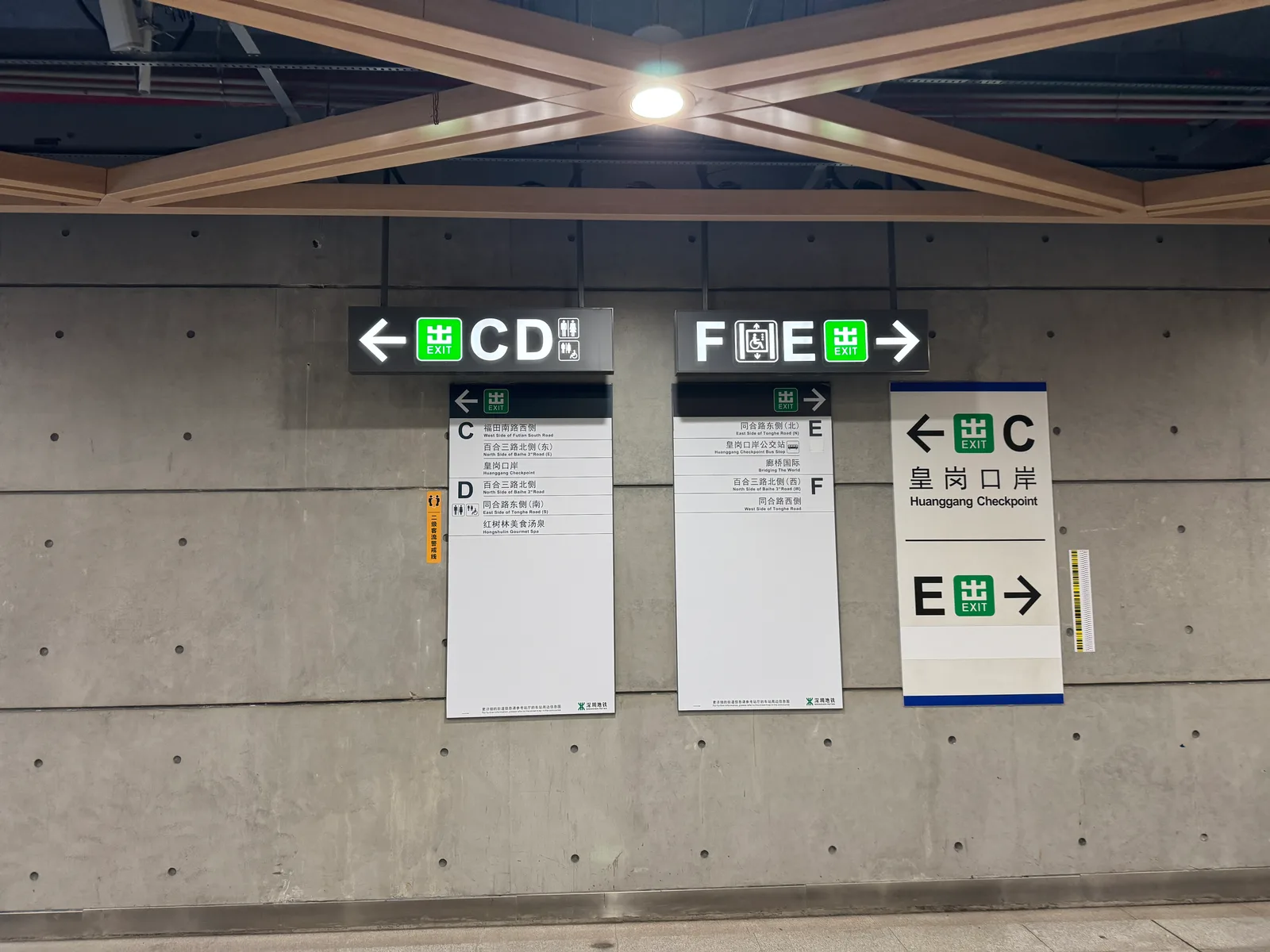
Two practical overnight realities matter more than the headlines. First, the building is vertical: coaches arrive at L2, Hong Kong exit and mainland entry happen on L5, and you then descend to B1 for taxis and buses, B2 for the metro or B3 for ride-hailing. Reporters clocked the full walk-through at around twelve and a half minutes with no queue, and older travelers describe the lift-hopping as tiring. Second, Line 7 does not run overnight. The last trains from Huanggang Checkpoint leave at 11:23pm toward Xili and 11:38pm toward Tai'an, and the first ones are at 5:54am and 6:34am. A 2am arrival means a taxi from B1 or a Didi from B3, and the reporting is consistent that ride-hailing matches slowly in the small hours, so have your hotel's address in Chinese ready and expect to wait.
The Shenzhen side: Line 7 and what is within walking distance
Huanggang Checkpoint station sits on Line 7, the line that curves from Xili in Nanshan through Futian to Tai'an in Luohu, and the new terminal's B2 level links directly into it. The useful connections: one stop west to Fumin for Lines 4 and 10 into the Futian CBD, three stops to Shixia for Line 3, and six stops west to Chegongmiao for Lines 1, 9 and 11 toward Nanshan and the theme parks. Huaqiangbei's electronics markets are a Line 7 ride east. Futian Checkpoint station, where the Lok Ma Chau Spur Line crossing lands, is a few hundred metres away on foot but not on Line 7.
Around the port itself, Huanggang is a residential and office pocket on the southern edge of Futian rather than a sightseeing district, which makes it a good overnight base: cheaper than the CBD core, and the point is the crossing, not the view. The restaurants that matter are a metro ride away; the Shenzhen food guide covers where to point yourself once you have dropped the bags, and the things-to-do guide builds the day from Futian outward.
Huanggang vs Lo Wu vs Futian Checkpoint vs high-speed rail
The parent post compares all seven land crossings. These are the four a first-time visitor actually chooses between, from a central Hong Kong starting point:
| Huanggang | Lo Wu | Futian Checkpoint (Lok Ma Chau Spur) | High-speed rail | |
|---|---|---|---|---|
| Hours | 24 hours | 6:30am–midnight | 6:30am–10:30pm | Timetable, roughly 7am–10:30pm |
| From Hong Kong | Coach from Mong Kok, TST, Wan Chai, Lam Tin, Tsuen Wan; buses B10–B15; taxi | East Rail Line to Lo Wu terminus | East Rail Line to Lok Ma Chau | West Kowloon station |
| Time from Tsim Sha Tsui | 45–75 min on the coach plus 5–15 min clearance | 40–50 min train plus 10–30 min clearance | 45–55 min train plus 10–20 min clearance | 14–18 min train plus a 45–60 min arrival buffer |
| Cost | HK$45–63 coach, HK$10.5–27.6 bus | About HK$50 on Octopus | About HK$50 on Octopus | HK$75–90 second class |
| Lands you at | Line 7, Futian south | Line 1, Luohu and Dongmen | Lines 4/10, Futian | Futian station, Lines 2/3/4/11 |
| Visa desk | Yes | Yes | No | No |
| Best for | After midnight, late flights, groups with luggage | Dongmen, the visa desk on a weekday morning | Quieter rail crossing into Futian | Speed to the CBD, visa-free passports |
The honest read of that table: in daylight with a visa-free passport and a backpack, the high-speed train still wins, and Lo Wu or the Spur Line are the budget rail answers.
Where to stay near Huanggang Port
Three places to book in Shenzhen
 Closest reliable chain
Hampton by Hilton Shenzhen Futian Port
The hotel that shows up first on both Booking.com's and Trip.com's near-Huanggang lists, a ten-minute walk from either crossing with breakfast included. The sensible pick for a 1am arrival when you want a known brand and a short taxi.
Check availability Best reviewed nearby
IntercityHotel Shenzhen Futian Huanggang
A newer German-brand business hotel with thousands of recent reviews averaging above nine on both platforms, and rates that often undercut the Hampton. A short taxi or a Line 7 hop from the port; good value if you are staying two nights rather than one.
Check availability Full-service option
Four Points by Sheraton Shenzhen
The established full-service hotel in the free trade zone, a ten-minute walk to Futian Checkpoint and a few minutes' drive from Huanggang. Pool, proper restaurants and a shuttle to the ports in daytime; the choice when a late crossing is the end of a long travel day rather than the start of a cheap one.
Check availabilityWhere to base yourself depends on whether the port is the reason for the trip or just the way in. Stay in Huanggang itself if you are landing after midnight or leaving before dawn: it is a short taxi from the B1 level, the chain hotels above are reliable, and the area is quiet in a way that suits a sleep-and-go night. It is not where you want to spend an evening. Stay in Futian CBD around the Convention Centre and Coco Park if you have a normal daytime crossing and want the malls, the Ping An tower and the metro spine on the doorstep; it is one Line 7 stop to Fumin and a change to Line 4, and a far better place to eat. Stay in Luohu if the trip is really about Dongmen's food streets and the massage places, because Line 7 runs east to Tai'an and Line 1 is one change away, and rooms there are the cheapest in the city for the standard. The district-by-district guide goes deeper on all three plus Nanshan and Shekou.
Who should use Huanggang, and who should not
Late flights into Hong Kong airport. If you land at HKG after about 9pm with Shenzhen as the real destination, every rail option is closing by the time you have cleared Hong Kong immigration and reached the city. A pre-booked cross-boundary MPV from the airport, or the A21 bus to Tsim Sha Tsui and the Austin Road coach, puts you in a Futian hotel by 1am through a door that is still open.
Overnight arrivals in general. Red-eye trains or buses that drop you in Hong Kong before 6:30am, a night out in Lan Kwai Fong that ends with a Shenzhen hotel booking, an early flight out of Shenzhen Bao'an: all of these are Huanggang problems, and now that the clearance itself runs in minutes, the only real constraint is onward transport on the Shenzhen side.
Groups with luggage. A family of four with suitcases crossing at Lo Wu means an East Rail ride, a long footbridge, a queue, and a Line 1 platform. The same family on a coach from Wan Chai or in a hired car stays seated until the L2 bays and takes a lift to immigration.
Who should not. Anyone crossing between 7am and 9pm with a visa-free passport and a day bag is still better served by the high-speed train or the Spur Line; the coach from central Kowloon can take longer than the train plus buffer. And anyone crossing on a Chinese public holiday should treat Huanggang like every other port that weekend: the 18 October Chung Yeung Sunday produced reported waits of 90 minutes to two hours while the government maintained that the departure hall itself held waits within 30 minutes. Lawmakers blamed unfamiliar procedures, the traffic surge and computer problems. Expect it to improve; do not assume it already has.
What I would tell a friend crossing at Huanggang
- Northbound, you arrive at L2 by coach, go up to L5 for both checks, and come down to B1 for taxis, B2 for Line 7 or B3 for ride-hailing; southbound the sequence is B1 security, L4 clearance, L2 coaches.
- Foreign passports use the manual counters; walk past the automated gates rather than joining their queue, and have the passport open to the photo page before you reach the desk.
- The Mong Kok coach is the busiest pickup on a Saturday night; Tsim Sha Tsui and Lam Tin were nearly empty at 1am on the worst weekend so far.
- Line 7 closes around 11:30pm and reopens around 6am, so a night crossing ends in a taxi; screenshot the hotel address in Chinese while you are still on Hong Kong wifi.
- Octopus pays for the coaches and buses up to the port; nothing after it, so have Alipay or WeChat Pay set up before you leave Hong Kong.
- Skip Chinese public holidays entirely, and on any weekend aim for a mid-morning or mid-afternoon crossing rather than 9 to 11am north or 5 to 8pm south.
- The yellow bus is gone and the Lok Ma Chau Control Point is closed to passengers; any guide that mentions either is pre-October 2026.
I will keep this page current as the kinks get worked out, and the seven-crossing comparison stays the place to decide which door your particular day needs. If you have crossed at the new terminal, especially overnight or with a foreign passport at the manual counters, tell me what matched and what did not.
Frequently asked
Is Huanggang Port open 24 hours?
Yes. Huanggang is the only round-the-clock passenger land crossing between Hong Kong and Shenzhen, and the rebuilt terminal that opened on 12 October 2026 kept the 24-hour service. The catch is the transport around it: Shenzhen metro Line 7 stops running at Huanggang Checkpoint around 11:30pm and restarts around 6am, and on the Hong Kong side only the short-haul coaches, overnight bus NB73 and a few night minibuses run through the small hours.
Has the new Huanggang Port opened?
Yes. The redeveloped Huanggang Port opened to the public at 6:30am on 12 October 2026, confirmed by a joint notice from Hong Kong's Security Bureau and Shenzhen's port office. Both immigration checks now happen inside one building under a co-location arrangement, and the old Lok Ma Chau Control Point and the yellow shuttle bus between the two sides were retired the same morning.
How do I get from Hong Kong to Huanggang Port?
By road only, since there is no MTR to the Hong Kong side. Short-haul cross-boundary coaches leave around the clock from Mong Kok (Arran Street, HK$45–50), Wan Chai (Exhibition Centre Station, HK$57–63), Tsim Sha Tsui (Austin Road, HK$50–55), Lam Tin (HK$55–60) and Tsuen Wan (HK$45–48). Franchised buses B10 to B15 run from the New Territories and Hong Kong Island for HK$10.5–27.6, and red or green taxis can drop you at the port's public transport interchange.
How long does it take to cross at Huanggang Port?
Through the gates, about five minutes on a normal day, and reporters have clocked door to door in the building at around 12 minutes. Eligible Hong Kong and mainland residents use 134 automated joint-clearance channels; foreign passport holders use the manual counters, where officers from both sides sit side by side. Holiday peaks are a different story: the first Chung Yeung weekend after opening produced reported waits of 90 minutes to two hours.
Can foreign passport holders use the new Huanggang Port?
Yes, through the manual counters rather than the automated channels. The joint self-service lanes are enrolled for Hong Kong permanent ID holders with a mainland travel permit and mainland residents with the right endorsement, so most overseas visitors present a passport at a staffed counter where Shenzhen and Hong Kong officers each complete their check. The port also hosts one of the 5-day Shenzhen port visa desks.
Which Shenzhen metro line goes to Huanggang Port?
Line 7. Huanggang Checkpoint station connects to the new terminal's B2 level, with the first trains around 5:54am toward Tai'an and 6:34am toward Xili, and the last around 11:23pm and 11:38pm. Futian Checkpoint station on Lines 4 and 10 is a separate crossing a short walk west and is not linked to Huanggang by metro.
Is Huanggang better than Lo Wu or the high-speed train?
It depends on the hour and the luggage. From 6:30am to late evening with a visa-free passport, the high-speed rail from West Kowloon is still the fastest way into central Futian, and Lo Wu lands closest to Dongmen. Huanggang wins after midnight, for late arrivals into Hong Kong airport, and for groups whose luggage makes an MTR footbridge crossing miserable, because you ride a coach or car from door to port.