Qianling Park, Guiyang: The Macaques, Hongfu Temple and How to Visit Without Losing Your Snacks
Qianling Park in Guiyang explained: the wild macaques and 2025 injury reports, Hongfu Temple, cable car and ticket prices, the 2026 reservation rule, metro and a 2-3 hour route.
Every Guiyang itinerary has one fixture inside the city, and it is a mountain full of monkeys. Qianling Park sits at the northwest edge of the center, close enough to Dashizi that locals treat it as a morning walk, and it packs a Qing-dynasty temple, a karst cave, a lake, a free zoo and around 900 wild rhesus macaques into 426 hectares of forest. I have not filmed Guiyang yet, but the park kept surfacing while I researched things to do and where to stay there, and two things stood out. First, there is no proper English guide to it: prices online range from free to 5 yuan, the transport advice predates the metro line that now stops at the gate, and nobody mentions that since May 2026 you cannot walk in without a reservation. Second, the monkeys are a genuine safety story, with more than 13,000 recorded injuries since 2020.
What Qianling Park actually is
Qianling Mountain Park opened in 1957 and covers 426 hectares of limestone hills in Yunyan district, less a city park than a piece of Guizhou's karst forest with paths through it. The pieces are stacked up the mountain. Hongfu Temple, founded in 1672 by the monk Chisong and still the largest Zen temple in the province, sits near the summit. The Jiuqu Trail, a zigzag of stone steps from the South Gate, is the classic way up and the heart of the monkey zone, with Qilin Cave off a 382-step side path. Qianling Lake, dammed in 1954, fills the valley behind, the zoo and panda hall sit on the eastern side, and a 510-meter cable car runs from near the South Gate to Kanzhu Pavilion, the highest viewpoint, looking over the basin of high-rises that Guiyang built because the hills left it nowhere else to go.
The single most useful fact: the park has been free since January 2024, when the 5 yuan ticket was scrapped, and the zoo and panda hall went free with it. The cable car, the boats and the temple's token 2 yuan are the only costs, so the whole visit comes in under 35 yuan even if you ride up and row.
The macaques: what the park's own numbers say
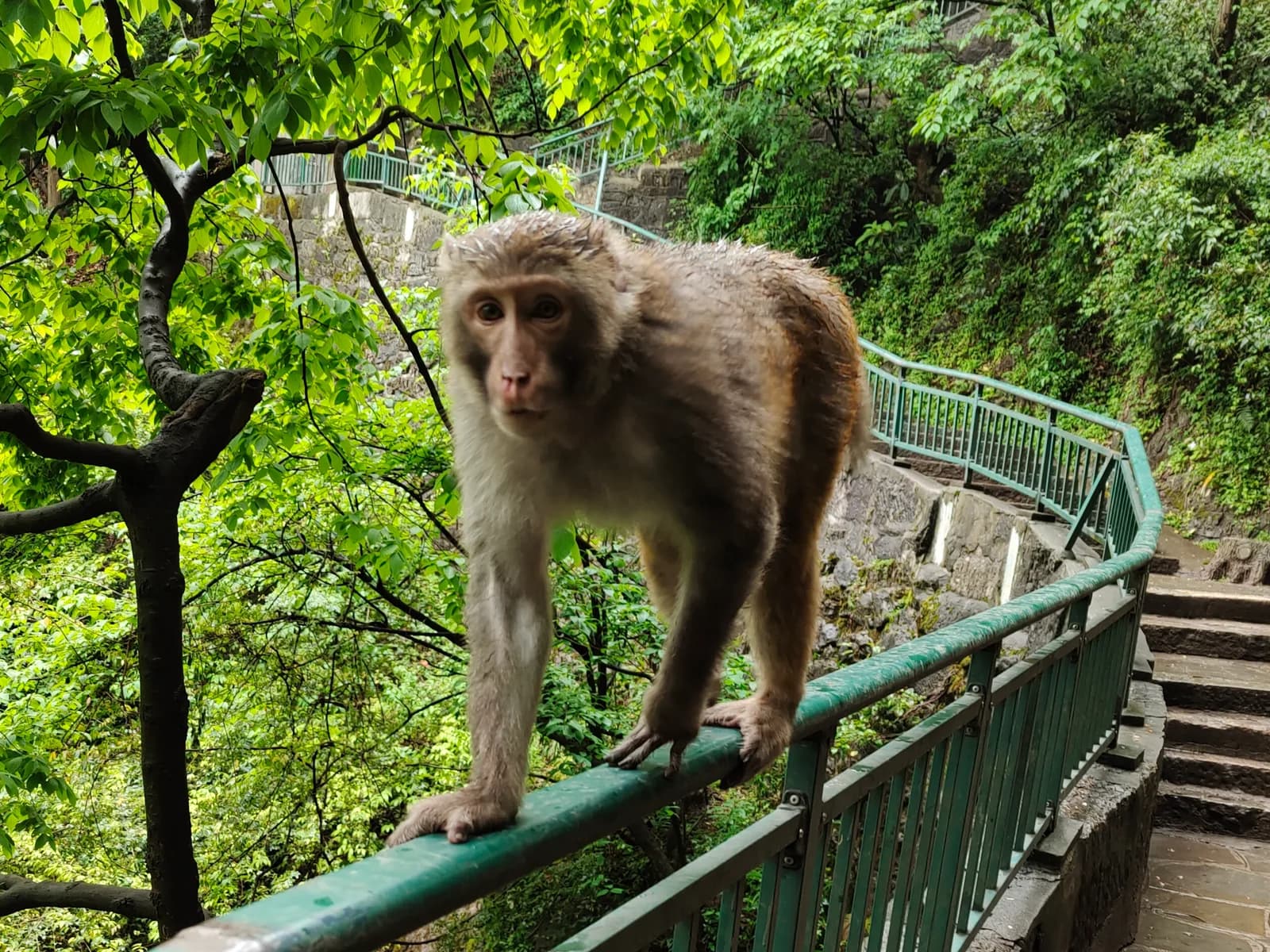
The monkeys are rhesus macaques, Macaca mulatta, a state second-class protected species, which is why the park cannot simply thin them. The 2024 survey counted 895 give or take 210, down from about 1,210 in 2020 but still double the estimated carrying capacity of 400. Relocation rounds in 2022 and 2024 were outpaced by breeding, and officials blame visitors feeding them sugary, salty processed food, which has shortened the interval between births and dulled their instinct to forage.
The human side is what every recent report circles back to. Guiyang's forestry bureau counts more than 13,000 injury incidents since 2020; by October 2025 the year's cases needing wound treatment had passed 1,600, and the district spends around 800,000 yuan a year on medical costs. On September 15, 2025, two women were chased and scratched minutes inside the gate by a monkey after their drinks, a man was clawed trying to get a stolen phone back, and the rabies, tetanus and immunoglobulin shots came to over 2,000 yuan, of which the park offered to cover only the rabies vaccine at 149 yuan a shot. In November an 8-year-old had a thumb bitten; the park's position is that it pays when a monkey attacks unprovoked and the visitor pays when feeding or teasing was involved. Draft macaque management rules published on October 29, 2025 cover population control, designated feeding zones, restricted areas and barriers, so expect tighter rules on the ground in 2026 than older reports describe.
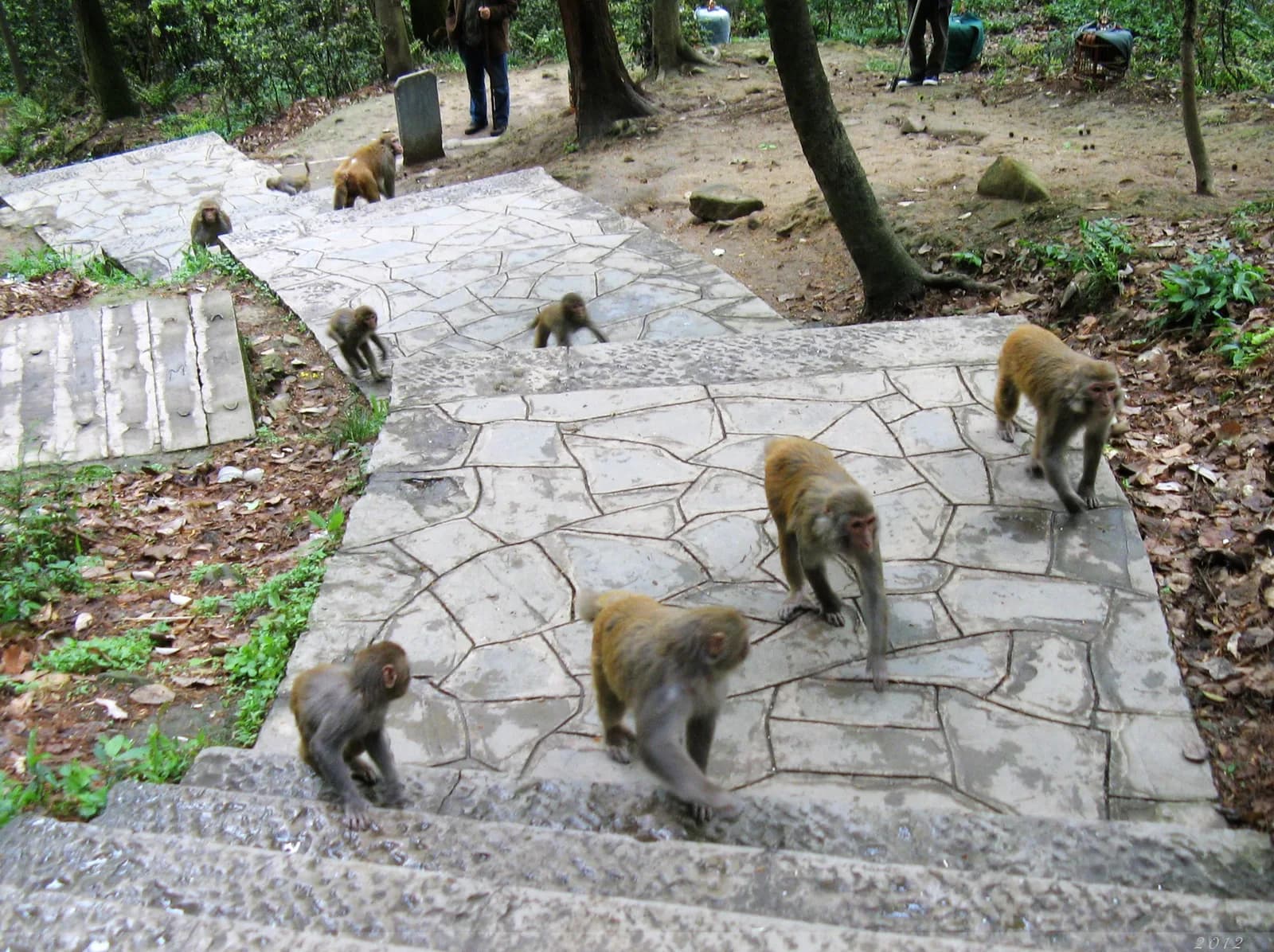
Where they concentrate is consistent across the bureau's data and traveler reports: Hongfu Temple and the paths around it, the Jiuqu Trail from the South Gate up, and the shore of Qianling Lake, with the stretch from the temple back downhill the one Chinese trip reports call thickest. Timing matters too: one domestic report describes arriving at 2pm to find the troop just awake from its midday rest and lined up along the Jiuqu Trail waiting for handouts, while English reviews from 2025 and 2026 say before 8am the monkeys are calm and the paths nearly empty.
How not to lose your snacks
The advice recent visitors converge on is the same set I laid out for the Tibetan macaques on Mount Emei, and it is unglamorous. Bury all food and drinks deep in a zipped bag before the gate and do not open it on the mountain; the September 2025 scratches started over a bottle. Carry nothing in plastic, because to a Qianling macaque plastic means food. Hold your phone with intent, and if a monkey takes something, let it go; pulling it back is how the bystander in that incident got the deepest wounds. No eye contact, a wide berth around mothers with infants and the big males, and the expert line from the November 2025 coverage: three meters and no feeding, ever. Children are overrepresented in the injury statistics, so keep them on the inside of the path and never let them hand food to a monkey, even when a local family is doing it. If you are scratched, wash the wound with soap and water and get rabies shots the same day at any large Guiyang hospital.
Hongfu Temple, the cave, the lake and the zoo
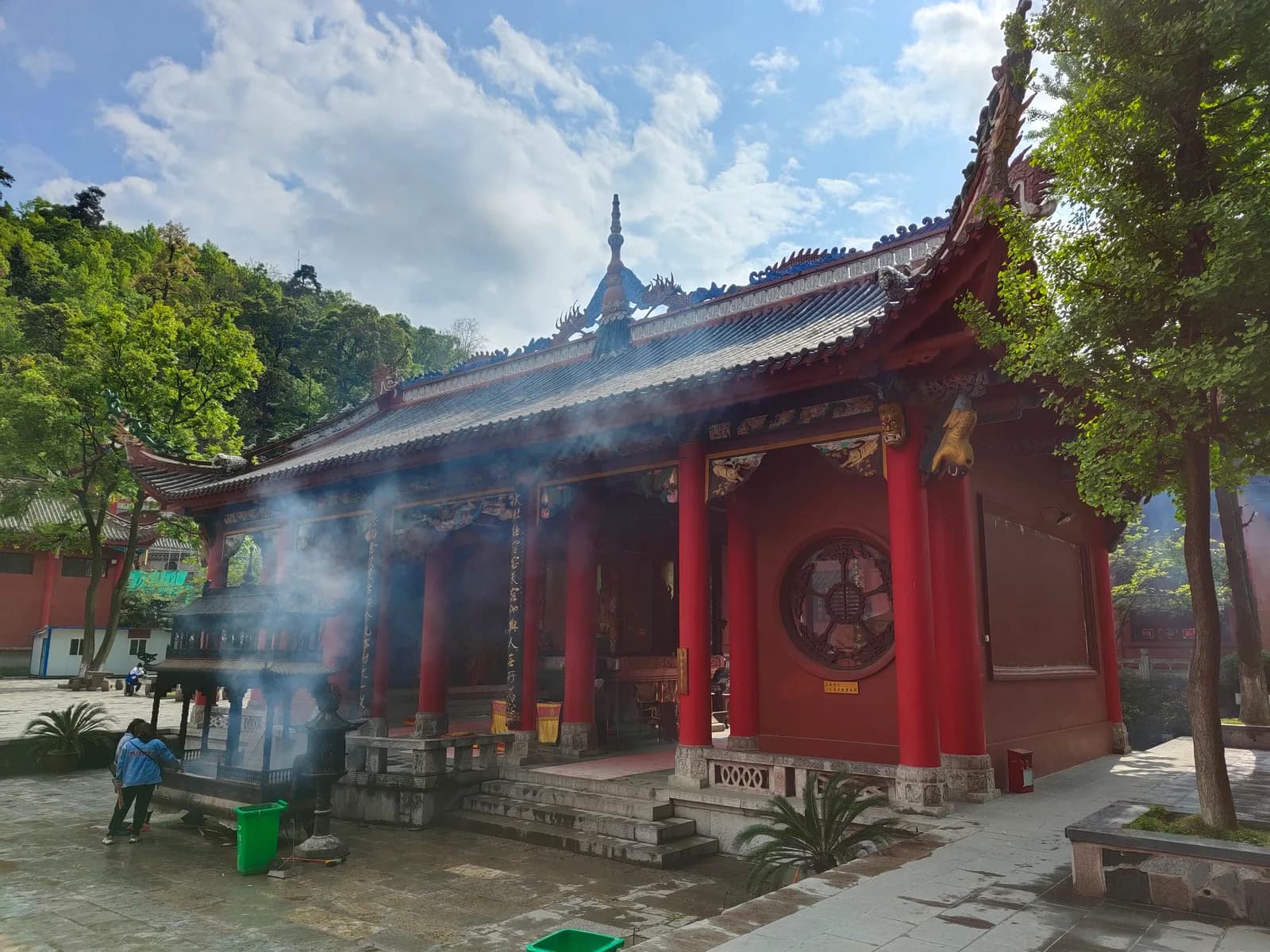
Hongfu Temple is a working Linji-school monastery rather than a museum, with two objects worth finding: a 1,500-kilogram bronze bell cast in 1469, two centuries before the temple existed, and a 900-kilogram jade Buddha from Myanmar in its own hall. A March 2026 reviewer singled out the Nine Dragon Wall and the quiet of the courtyards, and the recurring photo in domestic posts is the red walls against the forest. The first and fifteenth of the lunar month are the busy prayer days.
Qilin Cave is the side trip with the story: Zhang Xueliang, the general who kidnapped Chiang Kai-shek in 1936 to force a united front against Japan, was held here under house arrest in the early 1940s. It takes twenty minutes and is skippable if the steps have worn you down. Qianling Lake is the flat, easy part of the park, a 35-hectare reservoir with rowing boats at about 15 yuan an hour and, per the forestry bureau, its own resident monkeys, so the bag rules do not relax by the water. The zoo and panda hall are free (9am to 5pm and 10am to 5pm); recent reviews call the zoo small and dated and the panda hall the part worth the detour with children. Kanzhu Pavilion at the top of the cable car is where the city view lives.
Tickets, hours and the 2026 reservation rule
| Item | Price | Notes |
|---|---|---|
| Park entry | Free | Since January 2024; reservation required since May 1, 2026 |
| Hongfu Temple | ¥2 | Some reports say ¥3; either way nominal |
| Cable car | ¥20 up, ¥15 down, ¥30 return | 510 m, about 8 minutes; new cabins since late 2024 |
| Qianling Lake boats | ~¥15 per hour | Paddle and rowing boats |
| Zoo and panda hall | Free | Zoo 9am–5pm, panda hall 10am–5pm |
| Park hours | 7:00am–8:00pm | Changed May 2026; older sources still list 6:30am–10pm |
| Cable car hours | 8am–7pm summer, 8am–5pm winter | Queues build from late morning on weekends |
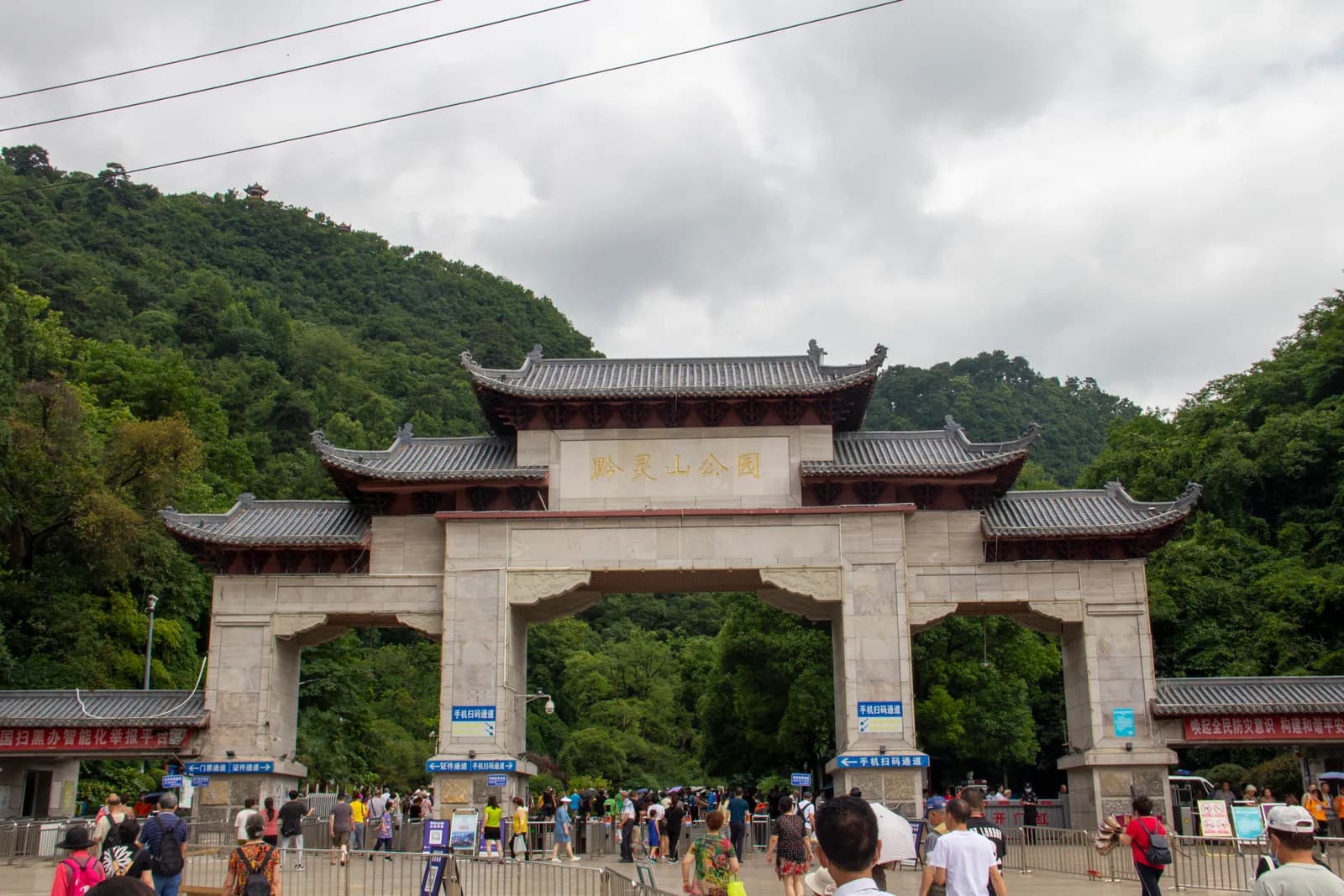
The reservation rule is what has caught out the most people this year. Since May 1, 2026 every visitor books through the park's official WeChat account (search 黔灵山公园) or the Guikehui mini-program with a name, ID number and phone number, picks a date and entry slot, then scans the QR code or an ID card at the gate; the notices say flatly that unreserved visitors will not be admitted. The gap for foreign travelers is that every notice is written around a Chinese ID number and none mention passports. My honest advice: try the mini-program with your passport number first, since many Chinese attraction systems accept one; if it refuses, ask your hotel desk to book for you, or arrive at the South Gate with your passport and find staff at the manual lane. A guided city tour removes the problem entirely.
Getting there from central Guiyang
The metro solved this in December 2023 and most English guides have not noticed. Line 3 has a station called Qianling Park; take exit C and the South Gate is 280 meters away. From Line 1 (Guiyang North station and the center) change at Beijing Road; from Line 2 (the airport) change at Yan'an West Road. Bageyan, one stop along Line 3, serves the East Gate, the closer entrance for the zoo and lake. Buses 1, 2, 16, 22, 51, 227, 235, 311 and 602 stop at Qianling Park. A Didi from the Jiaxiu Tower stretch of the river is about 4 kilometers, 15 minutes and 11 to 15 yuan, which from the hotels in Yunyan or Nanming makes the taxi the sane option at 7am and the metro any later.
A two-to-three-hour route, and the lazy version
The local guides publish the same loop and recent visitors confirm it works: South Gate, up the Jiuqu Trail through the macaque zone (Qilin Cave detour optional), Hongfu Temple after 20 to 30 minutes of steps, on up to Kanzhu Pavilion for the view, then down the far side to Qianling Lake, along the shore to the zoo and panda hall, and out the East Gate for Bageyan station. That is about 6 kilometers and three hours. The lazy version, the one local guides suggest for small children or bad knees, rides the cable car up, visits the pavilion and temple, and walks down the Jiuqu Trail with gravity on your side, one pass through the monkey zone instead of two, in about two hours.
| Route | Time | Cost | Monkey exposure | Best for |
|---|---|---|---|---|
| Classic loop on foot, South Gate to East Gate | ~3 hrs | ¥2 | High, on the Jiuqu Trail and at the lake | Fit walkers who want the whole park |
| Cable car up, walk down the Jiuqu Trail | ~2 hrs | ¥22 | Medium, one pass through the zone | Most first-timers, families |
| Lake and zoo only, from the East Gate | ~1.5 hrs | ¥15 for a boat | Low to medium | Rainy days, toddlers, second visits |
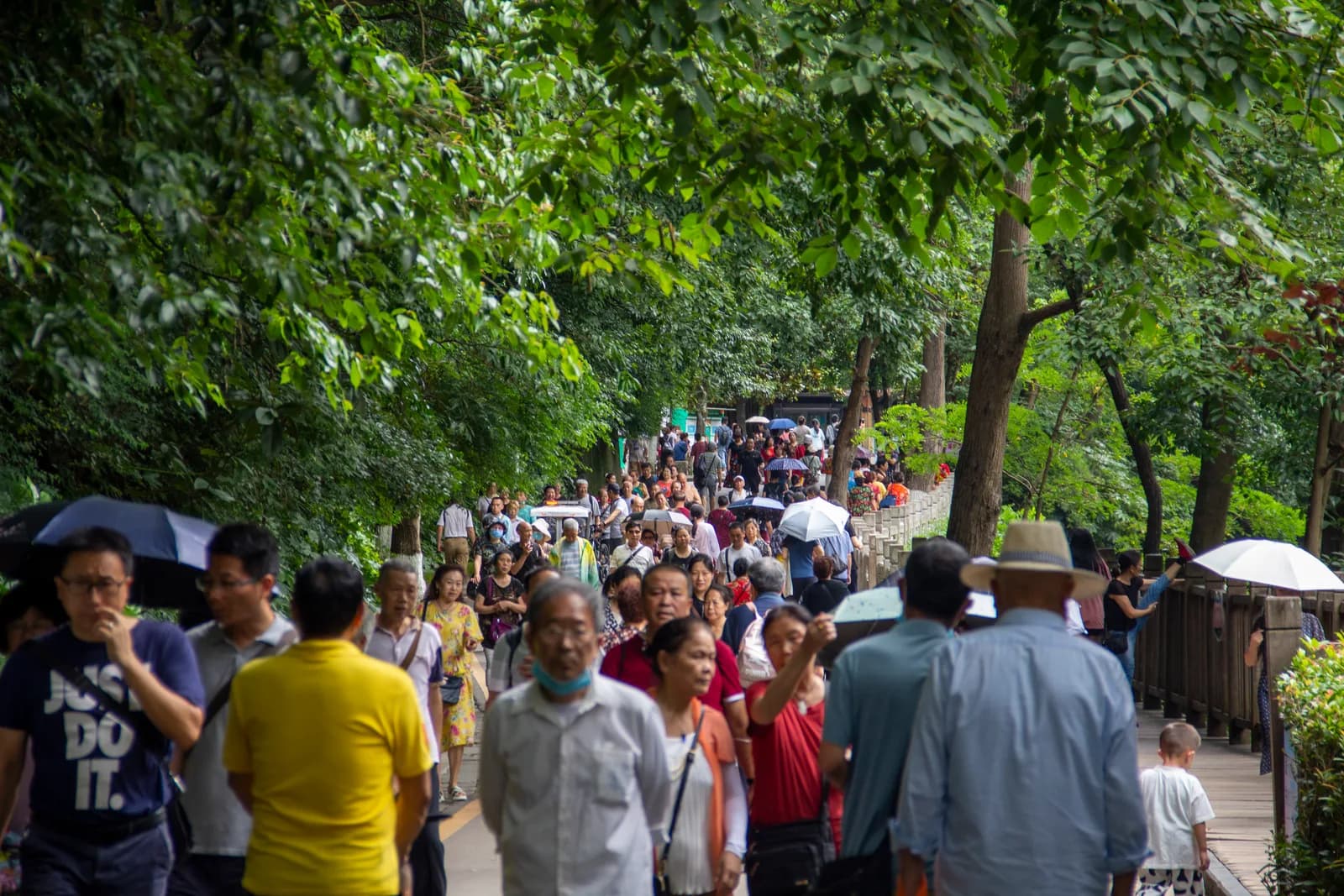
Best time of day is the least ambiguous finding in the research. Weekday, before 8am if you can manage it: quiet gates, empty temple courtyards, a forest about five degrees cooler than the streets, calm macaques. By 11am on a weekend the cable car queue is long and the main path turns into the procession in the photo below. This slots into the city day I mapped in the Guiyang things-to-do guide: Qianling in the morning, the Wenchang Pavilion and Jiaxiu Tower after dark.
Guided options, and the day trips the park pairs with
Nobody needs a guide to walk up a hill, but a private city tour earns its fee here: it handles the reservation, and it stitches Qianling to Jiaxiu Tower and Qingyan Ancient Town in one day, which is what travelers with a single city day end up doing anyway. Beyond that, the park is the warm-up act for the excursions that justify the trip to Guizhou.
Three things worth booking
 One-day city fix
Guiyang private day tour: Qianling Park, Jiaxiu Tower, Qingyan
The macaques and Hongfu Temple in the morning, the river pavilion and the 600-year-old garrison town after. The guide deals with the reservation system, which matters if you have no Chinese apps.
Book this The headline
Huangguoshu Waterfall day trip
Asia's largest waterfall, 30 minutes to Anshun West by high-speed rail plus a shuttle. Three scenic sections need six hours or more, so this is a whole day, not an afternoon after the monkeys.
Book this Worth the overnight
Xijiang Qianhu Miao Village
Over 1,400 wooden Miao houses stacked up two hillsides, reached via Kaili South station. Recent visitors stay the night for the dusk light-up rather than racing back to Guiyang.
Book thisI have written up Huangguoshu and Xijiang Miao Village separately; the point here is sequencing. Qianling is a morning, which makes it the right arrival-day activity and the wrong thing to squeeze in after a waterfall day when your legs are gone.
What to eat afterwards
The park delivers you back to the South Gate at lunchtime, and the food answer starts right there: Dan Jia crispy duck, one of Guiyang's signature snacks, has a branch beside the entrance, and the duck is fried through until the skin shatters. The snack streets locals send visitors to afterwards, Minsheng Road and Zhengxin Street, are back toward the center and worth the detour for guoba ciba (crisped rice cakes) and cuishao fried rice with crunchy pork lardons. One caution: older guides still point to the Hongbianmen and Shaanxi Road night markets on the park's east side, but Guiyang moved its street-stall night markets indoors from 2019 and those are gone.
For the evening, do what the Guiyang food section argues at length: a Didi to the Nanming riverside for sour soup fish at a dedicated restaurant, then Qingyun Market or Erqi Road for grilled stuffed tofu. Guizhou's fermented sour base is the reason I want to film this province, and a day that starts with monkeys and ends in a clay pot of suan tang yu is about as Guiyang as it gets. If you entered China through Hong Kong, the same eat-late logic runs through my Shenzhen food and sights guides.
Where to stay for an early start
The whole argument of this post is to be at the South Gate at 7am, so sleep accordingly. The full neighborhood breakdown is in my Guiyang stay guide; this is the compressed version.
Three places to book in Guiyang
 Walk to the gate
Qianling Grand Hotel
A big domestic hotel on Beijing Road about five minutes' walk from the park, with the metro at the door. Recent guests praise the location and the grounds and complain about old-fashioned service, so treat it as a base, not a splurge.
Check availability Best value
Novotel Guiyang Downtown
Two minutes from the Grand Cross Square crossroads, a short Didi or one metro change from the park. Big clean rooms and a location guests score above 9; the recurring caveat is patchy English at the desk.
Check availability Splurge
Kempinski Hotel Guiyang
The 53-story landmark of the central business district, a ten-minute drive from Qianling Park. Recent guests rate it around 9 and single out the breakfast, which is the right fuel for the Jiuqu Trail.
Check availabilityStay on Beijing Road by the park if the monkeys are the reason you are in Guiyang: the hotels here are domestic chains and older state-style properties, English at the desk will be thin, but the South Gate is a walk and the Line 1 and Line 3 interchange is beneath you. Stay in Yunyan around Dashizi for the classic first-visit compromise, a 10-minute Didi from the gate and walking distance to the Wenchang Pavilion and the shopping streets. Stay on the Nanming riverside if evenings matter more than mornings, which for me they do: Jiaxiu Tower and both night markets are on foot and the park is a 15-yuan taxi at dawn.
The honest verdict
Is Qianling Park the best thing to do inside Guiyang? For most travelers, yes, and it is not close. It is free, it is on the metro, and no other provincial capital in China offers a working 17th-century monastery, real karst forest and several hundred wild macaques in one morning. Jiaxiu Tower and the Wenchang Pavilion are better after dark; the provincial museum is a rainy-day hour; Tianhetan is better karst but a half-day ride away. With one day in the city, Qianling is the morning.
The caveats are real. The monkey problem is worse than five years ago, the park's own numbers say so, and a visit with children needs the bag discipline of a hike through bear country. The reservation rule adds friction for foreign passport holders. And it is a city park, not a wilderness: paved paths, crowds by 10am, a summit view of tower blocks. Set expectations there and it delivers. On a wider route through Chengdu it rhymes with Mount Emei, the same macaque rules at a fraction of the effort, with the Chengdu sights, a Chengdu bed and the Leshan Buddha a 3.5-hour train away.
Recommendations
- Reserve your slot on the Guikehui mini-program or the park's WeChat account the day before; since May 2026 there is no walking in.
- Be at the South Gate for the 7am opening on a weekday, when the paths are empty and the macaques are calm.
- Bury every snack and drink in a zipped bag before the metro and carry nothing in plastic; the monkeys read plastic as food.
- Keep three meters from any monkey, skip eye contact, and let go of anything they grab; the deepest 2025 injuries came from fighting for a stolen phone.
- Take the cable car up (20 yuan) and walk down the Jiuqu Trail with children or bad knees; it halves the time in the monkey zone.
- Pay the 2 yuan for Hongfu Temple and find the 1469 bronze bell and the jade Buddha; the courtyards are the quietest place on the mountain.
- If scratched or bitten, wash with soap and water and get rabies shots the same day; the park pays only if it agrees the attack was unprovoked.
Qianling changes faster than the guides to it, and 2026 has already brought a new reservation system, new cable car cabins and draft rules on the monkeys, so if you have walked the Jiuqu Trail recently and the numbers above have moved, tell me and I will update this. The shape of the advice will hold: go early, seal the snacks, and be back down the mountain in time for the rest of Guiyang and a pot of sour fish.
Frequently asked
How much does Qianling Park in Guiyang cost?
Entry has been free since January 2024, when the old 5 yuan ticket was dropped, but since May 1, 2026 you need a real-name reservation to get through the gate. Inside, Hongfu Temple charges 2 yuan, the cable car is 20 yuan up, 15 down or 30 return, rowing boats on Qianling Lake run about 15 yuan an hour, and the zoo and panda hall are free. A full visit with the cable car comes to under 35 yuan.
Are the monkeys at Qianling Park dangerous?
They are bold enough to hurt people. The park's own figures show more than 13,000 recorded injury incidents since 2020, over 1,600 of them needing wound treatment in 2025 alone, and most involve food, plastic bags or someone feeding a monkey. Keep every snack sealed inside a bag, carry nothing in plastic, keep about three meters away, do not make eye contact and hold children close, and the macaques mostly ignore you. If you are scratched or bitten, wash the wound and get rabies shots the same day.
How do you get to Qianling Park from central Guiyang?
Metro Line 3 stops at Qianling Park station and exit C is a four-minute walk from the South Gate; from Line 1 change at Beijing Road, from Line 2 change at Yan'an West Road. Bageyan station, also on Line 3, serves the East Gate. Buses 1, 2, 16, 22, 51, 227, 235, 311 and 602 stop at the park, and a Didi from Jiaxiu Tower is about 4 kilometers, 15 minutes and 11 to 15 yuan.
Do you need to book Qianling Park in advance?
Yes, since May 1, 2026. Reservations go through the park's official WeChat account or the Guikehui mini-program, with your name, ID number and phone number, a date and an entry time slot, and you scan the QR code or ID at the gate. The published process is built around Chinese ID numbers and no official notice mentions passports, so try the mini-program first, ask your hotel to help if it refuses a passport, or book a guided tour that handles entry. Visitors over 60 use a separate lane without booking.
How long do you need at Qianling Park?
Two to three hours covers the classic loop: South Gate, the Jiuqu Trail up through the macaque zone, Hongfu Temple, the viewpoint at the top of the cable car, then down to Qianling Lake and the zoo. Taking the cable car up and walking down cuts it to about two hours. Recent visitors who add the boats, the panda hall and Qilin Cave stretch it to four or five.
What is the best time of day to visit Qianling Park?
Early on a weekday. Recent reports agree the gates are quiet before 8am and the monkeys are calmer then, while by 11am on a weekend the cable car queue is long and the main path is a procession. Chinese trip reports note the macaques wake from their midday rest around 2pm and gather along the Jiuqu Trail looking for handouts, which is the liveliest and riskiest hour.
Is Qianling Park worth visiting?
Yes, and for most travelers it is the best single thing inside Guiyang itself. It is free, on the metro, and the combination of a working Qing-dynasty temple, real forest and several hundred wild macaques does not exist in any other Chinese provincial capital. It is not a substitute for the day trips: Huangguoshu, Xijiang and Qingyan are why people come to Guizhou, and Qianling is the morning you spend before the trains.
More from the journal
Emeishan Day Trip from Chengdu: What One Day on Mount Emei Really Buys You (and When to Stay the Night)
Hong Kong to Shenzhen Border Crossings: All Seven Doors Compared, and Which One Your Day Actually Needs
Leshan Day Trip from Chengdu: The Giant Buddha, the Boat Question and China's Quietest Great Food City